ChatGPT Ads Are Live in Singapore. Should You Actually Spend On Them?
The honest budget call on ChatGPT Ads vs AEO for Singapore business owners.
Table of contents
Free Website Audit
We'll personally review your website across 6 areas. UX, SEO, performance, mobile, conversion, and send you a detailed, actionable report within 48 hours. No cost. No catch.
ChatGPT Ads launched in Singapore on 23 September 2026, alongside six other Southeast Asian markets and Taiwan. For most Singapore businesses, the honest answer right now is not yet. Early estimates put ChatGPT Ads at roughly US$3 to US$5 per click, broadly in line with Google Ads, but without any proven Singapore conversion track record. Budget is usually better spent on Answer Engine Optimisation (AEO) and content that keeps earning traffic long after an ad budget runs out. The exception: a business with spare cashflow and genuine first-mover ambition may want to test ChatGPT Ads for a month, precisely because almost nobody in Singapore has yet.
What Changed When ChatGPT Ads Launched in Singapore on 23 September?
OpenAI confirmed on 23 September 2026 that ChatGPT Ads are now live in Singapore, together with Indonesia, Malaysia, the Philippines, Thailand, Vietnam, and Taiwan. It is the first time paid placements have appeared inside ChatGPT's answer flow in this region, sitting next to organic answers rather than on a separate results page.
OpenAI says the ads platform reached more than US$1 billion in annualised revenue globally within 200 days of launch, with tens of thousands of advertisers already running campaigns, per its own official announcement. Those figures come from OpenAI itself, not an independent audit, so treat them as a scale signal rather than a settled fact. The same announcement confirms self-serve access through OpenAI's Ads Manager for qualifying businesses, alongside managed partnerships with major agency networks, so a Singapore SME does not need an agency relationship just to set up a first campaign.
Reaching that revenue pace in 200 days puts real pressure on OpenAI to keep opening new markets, and Singapore is an easy technical launch: English-first, high digital adoption, and already comfortable with AI tools. That makes the timing more about OpenAI's own growth curve than about proven demand from Singapore advertisers, which is worth keeping in mind when reading the headlines.
What matters more for a Singapore business is narrower: almost nobody local has written about this yet. A live search for "chatgpt ads singapore" currently returns no ranking pages at all, which is unusual for news this significant. That gap lines up with a wider shift already under way, where more buyers ask AI tools direct questions instead of typing keywords, which is exactly the territory Answer Engine Optimisation (AEO) is built to compete in.
ChatGPT Ads vs AEO: The Real Budget Decision
The real decision is not ads versus AEO as a strict either/or. It is a budget-allocation call: where does the next marketing dollar do more for a Singapore business, a paid placement inside ChatGPT, or content that keeps earning organic and AI citations for years?
What Do ChatGPT Ads Actually Cost?
Early estimates put ChatGPT Ads at roughly US$3 to US$5 per click and US$25 to US$60 per thousand impressions (CPM), based on agency benchmarking from WebFX and Lapis, not OpenAI's own published rate card. Neither source has Singapore-specific data yet, and both explicitly label their numbers as early or emerging estimates.
On paper, ChatGPT Ads look comparable to or cheaper than Google Ads in some Singapore verticals. What the comparison cannot show yet is conversion quality. Google Ads carries years of Singapore-specific data behind it, including ALF's own work with BigFundr, where disciplined CPC bidding and a tested landing page turned paid clicks into qualified leads. ChatGPT Ads has none of that history in this market.
What Does AEO and Content Spend Actually Buy?
AEO and content spend buys a compounding asset, not a rented one. A ranking article keeps generating traffic, leads, and AI citations for years after it is published, with no recurring per-click cost. Our guide to how AI Overviews cite Singapore content explains how content earns those citations, and a five-metric framework for tracking that return sets out how to actually measure it, since traditional rank tracking will not show it.
The economics behind that are simple. A single article that earns a genuine citation costs the time to research and write it once, then nothing more, and it keeps generating visits, leads, and AI citations for as long as it stays accurate and well-linked. A paid placement stops the moment the budget does, with nothing left behind to show for it.
What Does a ChatGPT Ad Actually Look Like?

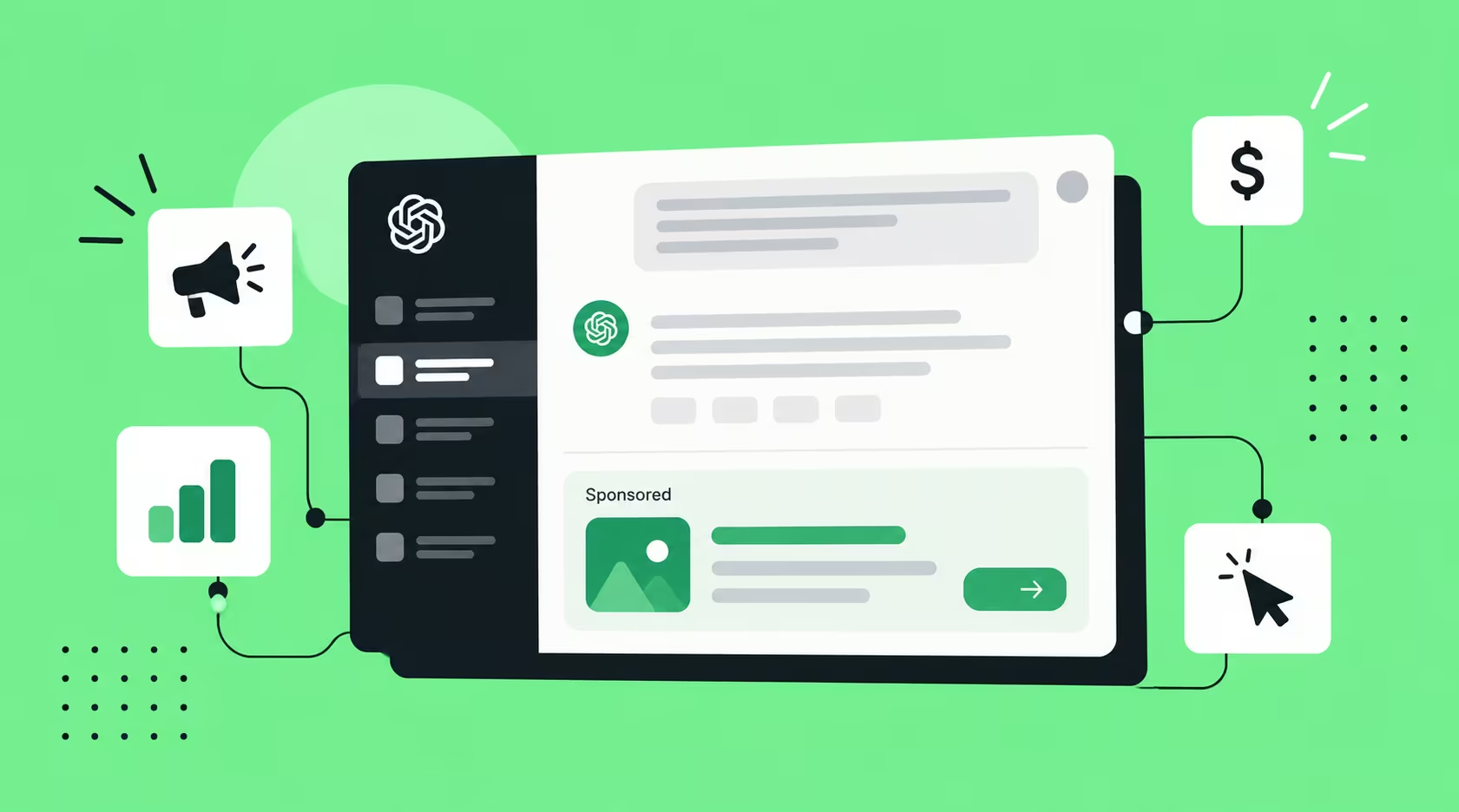
A ChatGPT ad appears below the end of a response, not inside it, and is clearly labelled as sponsored and visually separated from ChatGPT's own answer, according to OpenAI's own help documentation. The system shows one or more ad units only when it judges a genuine match to the conversation, selected using a mix of conversation context, the advertiser's targeting, and bid strength.
- Ads do not appear inside the ChatGPT Atlas browser during testing
- Ads are excluded from Temporary Chats
- Ads are kept away from sensitive topics such as personal health or politics
- Users can hide, report, or ask ChatGPT about any individual ad through a three-dot menu
That placement matters for the nuisance theory below. An ad sitting below a finished answer, clearly marked and easy to dismiss, is a gentler interruption than a pop-up blocking the answer itself. Whether Singapore users read it that way in practice is still unknown, since almost nobody locally has reported seeing one yet.
Why the 'Meh' Reaction Might Be Biased
Much of the early "meh" reaction to ChatGPT Ads online comes from a specific crowd: people who already work in SEO, AEO, or GEO. That group has a professional reason to prefer earned visibility over paid placement, so their scepticism is not neutral. A Singapore business owner without that lens might reasonably see the same launch differently, especially given how few people have actually seen one of these ads.
I have not run ChatGPT Ads myself. My read comes from watching the rollout and how other agencies are covering it, not from a live campaign, and it is worth being upfront about that.
I also have not seen a ChatGPT ad appear in my own account, which is itself a data point. If even a regular, professionally curious user has not encountered one, exposure in Singapore is still genuinely low, and any early click-quality data will be thin for a while yet.
The Honest Exception: First-Mover Advantage in Singapore
My standing advice to clients trying a new channel is to wait, watch what others do for a month, and avoid jumping the gun. I would tell most businesses to save that budget for AEO and content work that actually moves the needle.
There is a genuine exception to that advice, and it is worth naming honestly rather than smoothing over. Singapore is one of the first markets where ChatGPT Ads exist, and almost nobody is using them yet. A business with spare cashflow, curious about a new channel, has a real reason to test it for a month specifically because it is new here, not despite that.
To be clear about what "spare cashflow" means here: money not already earmarked for a channel with a proven return, that the business can afford to treat as a learning cost rather than a growth lever. If that describes the budget, and there is genuine curiosity about a new channel, there is a reasonable case for trying it, with the downside capped at a month's disposable spend.
What If You Wait Too Long?
Waiting has a real cost too, not just a safe default. Every week a Singapore business does not test ChatGPT Ads is a week a competitor could claim the first-mover position instead, in a channel with almost no local competition to push costs up.
Early advertisers on a new platform can sometimes lock in cheaper costs before demand catches up and bidding gets competitive. That happened on Google Ads in its early years, and on Meta's ad platform before it matured into an auction most small businesses now find crowded and expensive. ChatGPT Ads could follow the same curve.
The counterargument does not overturn the case for AEO first. It sharpens the exception already named above: if a business genuinely has room in its budget and enough curiosity, a short, deliberately time-boxed test is a reasonable hedge against being locked out of a cheap early auction later. What it does not justify is treating ChatGPT Ads as a core, ongoing budget line before any Singapore conversion data exists to justify one.
How much this matters also depends on the business. A direct-to-consumer brand with a low consideration purchase has more to gain from testing quickly, since the buying decision happens fast and a cheap early click can convert almost immediately. A professional services firm selling a considered, high-value engagement has less urgency, since AEO and referral trust usually carry more weight in that decision than any single ad click.
What Should You Actually Do This Month?
For most Singapore businesses, the practical answer is to put new budget into AEO and content first, and treat ChatGPT Ads as a small, time-boxed experiment rather than a core channel, at least until real Singapore performance data exists.
A workable version of that plan: keep the bulk of the marketing budget on SEO and AEO work that keeps compounding, set aside a small, genuinely disposable amount for a one-month ChatGPT Ads test if cashflow allows it, and review both against actual leads, not just clicks, before deciding whether to continue either.
If a one-month test does go ahead, run it with the same discipline as any other paid channel:
- Set a hard, disposable budget cap for the month before launching, separate from any always-on AEO or content spend.
- Point ads at a page that already exists and converts, not a new landing page built just for the test.
- Track leads and enquiries, not just clicks, since click-through tells you almost nothing about conversion quality this early.
- Review the result after four weeks against that same bar, and stop if it has not earned its place, rather than letting it drift into a permanent line item by default.
Frequently Asked Questions
Does ChatGPT Ads targeting use my chat data?
OpenAI has said ChatGPT Ads targeting draws on conversation context and account signals rather than a traditional third-party cookie profile, similar in spirit to how search ads use query intent. OpenAI's own privacy documentation is the primary source for exactly what is and is not used, and it is worth reading directly before running a campaign, since the specifics matter more than the general claim.
Which ChatGPT plans show ads?
Ads currently appear only for people on ChatGPT's free and lower-cost plans. OpenAI's own announcement of the Singapore rollout confirms paid subscription tiers remain ad-free, so a business testing this channel is reaching ChatGPT's free-tier audience specifically, not its full user base.
Can I turn off ChatGPT Ads?
As a user, upgrading from a free or lower-cost plan to a paid ChatGPT subscription removes ads entirely, based on OpenAI's own positioning. As an advertiser, campaigns set up through OpenAI's self-serve Ads Manager can be paused or stopped at any time, the same as most self-serve ad platforms.
Should I try ChatGPT Ads if I have no AEO or content marketing in place yet?
Generally, no. ChatGPT Ads work best as a small addition on top of a content and AEO foundation that is already earning some organic and AI visibility, not as a substitute for one. A business with nothing else in place is usually better off building that foundation first, since it is the asset that keeps paying off, before spending anything on an unproven paid channel.
Conclusion
Treat this as a budget decision, not a moral one. AEO and content remain the better default for most Singapore businesses because they keep paying off long after the spend stops, and that has not changed on 23 September.
If there is room in the budget this month, set aside a small, time-boxed amount to test ChatGPT Ads specifically because Singapore is still early, review it against real leads after four weeks, and put everything else into the content and AEO work that compounds.
{{build-better-experience="/directory"}}
Categories
Written By
.webp)
Resources
Related Articles
Deep dive into our latest news and insights.