AEO Explained: How Your Business Gets Cited by AI Search
A plain guide to AEO: how your business gets cited by ChatGPT, Claude and AI Overviews, and where to start.
Table of contents
Free Website Audit
We'll personally review your website across 6 areas. UX, SEO, performance, mobile, conversion, and send you a detailed, actionable report within 48 hours. No cost. No catch.
AEO, or answer engine optimisation, is how your business gets cited by AI tools. When someone asks ChatGPT, Claude or Google's AI Overviews about a service or product, your name should appear. AEO extends SEO. It does not replace it. Both reward useful content that answers what people ask. AEO adds a page structure that a machine can quote cleanly. For most Singapore businesses, start with a proper audit and a check on which pages AI tools already cite. Then repeat what works on other pages.
Which AI Tools Does AEO Cover?
AEO covers any tool that answers a question directly instead of listing links. Today that means AI Overviews in Google, ChatGPT, Claude and Perplexity. Each retrieves information differently, yet all of them favour clear, trustworthy pages.
You will also see GEO (generative engine optimisation) and LLMO used for the same idea. The labels vary by author, but the goal is the same: be mentioned and cited in AI-generated answers. I use AEO throughout this article for consistency.
Here is what success looks like. A buyer asks ChatGPT for a Singapore web design agency, and your business is named. If you want the practical steps, start with the steps for appearing in AI-generated answers.
How Is AEO Different From SEO?
AEO is SEO with a different finish. The foundation is identical: useful content that answers what your audience is looking for. What changes is how you structure each page, so a machine can pull a clean answer from it.
This is no longer about keyword stuffing. It is about relevant information that your users actually want, written clearly and organised well. I am not SEO trained. I learnt this by reading, testing on my own site and watching what gets cited. Treat my view as practitioner experience, not theory.
Search engines also read meaning now, not just matching words. They work out which entities a page is about and whether the site is a credible source on them. That is why building topic authority around entities sits underneath good AEO.
The last row is the one that matters. Both approaches depend on content people want. A thin or vague page will not get cited, however well it is structured.
What Stays the Same
- Intent: answer the question the person actually asked.
- Trust: accurate claims, named sources and real experience still carry weight.
- Structure: clear internal links and a crawlable page remain the base.
- Freshness: outdated facts lose both rankings and citations.
What Changes
Fix the substance before you touch the format. What changes is mostly presentation: where the answer sits, how headings read, and which machine-readable labels you add.
Are People in Singapore Really Using AI to Search?
Yes, in large numbers. The NUS Institute of Policy Studies surveyed 3,713 adults in Singapore aged 21 and above between October and November 2025. It found that over 60% use AI chatbots, according to Malay Mail's report on the survey.
Among those users, 81.2% use chatbots to look for information, reviews or recommendations. That is search behaviour. Yet 87.3% also agree that chatbots can mislead. My read: people use these tools to find businesses, yet they do not fully trust the answers. A citation from a credible, specific page carries weight.
AI has not replaced Google either. A wider Orbit Media survey found 55% of respondents use AI chat as a primary or frequent research tool. It is not specific to Singapore. For local and business searches, search still leads, with only 24% preferring AI.
Treat Google and AI tools as two channels for one job. Being findable in one and citable in the other needs only a slightly different page structure.
How Do AI Systems Decide What to Cite?
Nobody outside the AI companies knows the exact formula, and each tool retrieves information differently. What I can observe is that cited pages tend to be clear, specific and easy to quote. So I structure every page to make quoting effortless. I use all five habits below together. None is magic alone, but combined they make a page easy for readers and machines to understand.
Open With the Answer
Put the direct answer in the first sentence under every heading. The summary at the top of a page should answer the title question in about 100 words. An AI tool can lift that paragraph whole, and a busy reader gets the point at once.
Write Headings as Real Questions
Phrase most headings the way people search or prompt, such as 'How much does a website cost in Singapore?'. A heading that matches one real query gives an answer engine a clean entry point. Keep each heading to a single question, never two welded together.
Add FAQs That Cover New Ground
A FAQ section works when it answers questions the body has not already covered. Source them from real search queries, not your own guesses. Each answer then becomes a separate unit that a tool can quote and that you can mark up with schema.
Mark Up the Page With Schema
Schema markup labels what is on a page, such as an FAQ or an article, in code that machines read. It does not guarantee a citation. It removes ambiguity, which helps. For the detail, see what schema markup does for search visibility.
Use Tables for Comparisons
Anything genuinely tabular, such as prices, options or before-and-after results, belongs in a real table. Tables are easy for machines to parse and for readers to scan. A paragraph that lists rows is harder to quote correctly.
What Did BigFundr Show Me About AEO?
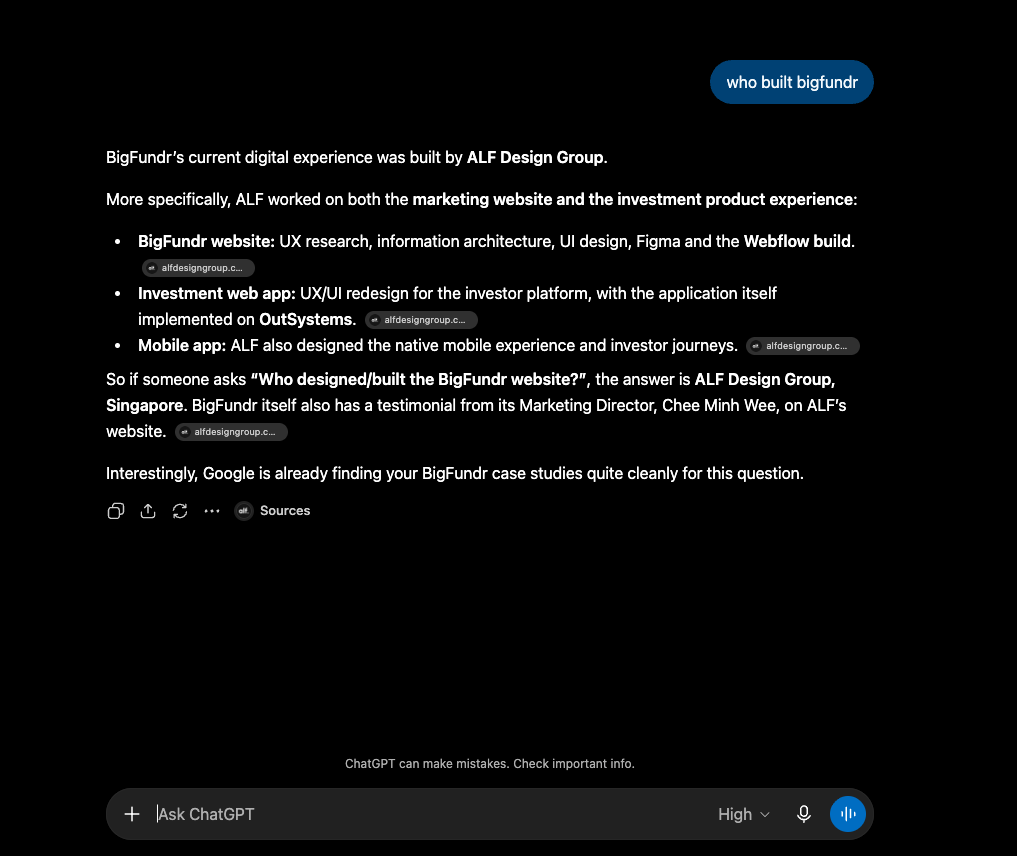
In late 2024, a prospective client told me they wanted to build something similar to BigFundr. They had found ALF by asking ChatGPT, 'Who built BigFundr?' Our name came up. It was the first lead I ever received from an AI tool.
The pages ChatGPT surfaced were our portfolio page and the article explaining how we created the BigFundr app and website. Neither was written for AI. Both explained the real work clearly. You can see the project in our BigFundr website case study.
That is my read of why it worked, not proof of cause, because I cannot see inside ChatGPT. My guess: a specific page about real work on a named project is easy for an AI tool to attribute.
If I had to name what to copy, it is three things. Name the project. Explain how it was built and why decisions were made. Keep the page specific enough that nobody could mistake it for another agency's work. This is my practice, not a proven formula.
I should be honest about what came after. AI citations have not become a major lead source for us. The most recent AI-sourced lead was also from ChatGPT, and I only know because I track enquiry sources. One good example is encouraging, but it is not a trend.
What AEO Doesn't Mean
AEO is not a trick, and it does not replace SEO. Three myths come up often, and I would skip all of them as a first step.
Does llms.txt Help You Get Cited?
Probably not yet. An llms.txt file is a plain-text file, proposed at llmstxt.org, that points AI tools to your key pages. It was the 'in-thing' for a while. Some SEO voices now call it useless, though I cannot prove that either way.
The data supports caution. A tracker reported by PPC Land counted 36,120 llms.txt files by May 2026. That is 8.8 times the 4,088 a year earlier. Yet an Ahrefs server-log study found 97% of those files received zero requests.
Adoption is rising, but there is no sign yet that AI tools read the file. That could change. If you already have one, leave it in place. Just do not make it your first move. Fix your pages first.
Do You Need a Separate AEO Agency?
Not really. Someone who understands SEO, or an SEO agency, should know what to adjust. I am not SEO trained, and I got my own site into reasonable shape by reading and testing. At ALF we fold AEO into the work we already do, which is how we handle SEO for Singapore businesses.
Will AEO Bring Quick Results?
No. My first AI-sourced lead arrived in late 2024, and AI leads have stayed small since. Pages that get cited build slowly, just as they do in search. Treat any promise of instant AI visibility with suspicion.
How Do You Track AEO?
Start with the free tools you already have. Google launched Search Generative AI performance reports in Search Console on 3 June 2026. As PPC Land reported, they cover AI Overviews and AI Mode, with impressions by page, country, device and date. Google is rolling them out to a subset of websites first, so you may not see them yet. AI data also still appears in the overall performance report.
Bing Webmaster Tools has an AI Performance report, in public preview since February 2026. Search Influence's walkthrough shows how often Copilot cites your pages. You can export daily totals, cited pages and the queries behind citations.
Paid tools cover more platforms. Ahrefs and Semrush both include AI visibility tracking, and aiclicks.ai is another option. You pay for the wider coverage. I compare the options in my guide to the metrics worth tracking for AEO.
The simplest tracking of all is knowing where an enquiry came from. I added a small custom-code snippet in Webflow that records the source when someone submits a form. That is how I spotted my most recent ChatGPT lead. Use the Google and Bing reports the same way. They show which pages AI features already surface, so you know what to replicate.
Where Should You Start This Week?
You do not need a budget to start. You need a few hours and an honest look at your own site. Here is the order I would follow.
- Audit your website properly. Check that your pages are crawlable, structured and answer real questions. A step-by-step audit of your site for AI search keeps this manageable.
- Check which pages AI tools already cite. Ask ChatGPT, Claude and Perplexity the questions your buyers ask, and look at AI Overviews in Google. Note which of your pages appear.
- Replicate what works. Take the structure of the pages that get cited and apply it to your other key pages.
- Keep doing the SEO basics. Publish new articles and target the right keywords for your industry.
For step two, use prompts that match how a real buyer would ask. Change the bracketed parts to suit your business.
- Who built [your best-known project]?
- What are the best [your service] agencies in Singapore?
- How much does [your service] cost in Singapore?
- What is [a term your buyers use]?
- Should I choose [your business] or [a competitor]?
Three of those four steps are ordinary SEO work, and that is the point. AEO is a tweak to how you build pages, applied on top of good SEO.
Frequently Asked Questions
What does AEO stand for?
AEO stands for answer engine optimisation. An answer engine replies with a direct answer instead of a list of links. Examples are ChatGPT, Claude, Perplexity and Google's AI Overviews. Optimising for them means shaping your content so those tools can find, understand and quote it.
Is AEO the same as GEO?
In practice, almost. It tested ways to make content more visible in generative engine responses. AEO tends to focus on being the direct answer. The work overlaps so heavily that I treat them as one.
Do ChatGPT, Claude, Perplexity and Google AI Overviews cite the same sources?
Not necessarily. Each tool uses its own retrieval and ranking, and results can vary by prompt and by day. So test in more than one tool rather than assuming a result in one carries over to the others.
How can I check whether my business appears in AI answers?
Ask each tool a question a buyer would ask. An example is 'Who are the best web design agencies in Singapore?' Note whether your business or pages appear. Repeat monthly, because answers shift. If you want your FAQs quoted, see writing FAQ sections that AI tools can quote.
Conclusion
Pick one page this week. Choose the one that earns the most search traffic or describes your best work. Ask ChatGPT, Claude and Perplexity the question that page should answer, and see whether it appears.
If it does not, restructure the page. Put the answer first and turn headings into questions. Add an FAQ and schema, and use a table for tabular content. Then refresh the page on a regular schedule so it stays current.
Add a source field to your enquiry form so you can see what is working. Small, measurable steps beat a big AEO project. Start with one page, then repeat on the next.
{{build-better-experience="/directory"}}
Categories
Written By
.webp)
Resources
Related Articles
Deep dive into our latest news and insights.