AI Overviews: How to Appear in AI-Generated Search Results
How Singapore businesses can earn citations in Google AI Overviews — the new front page of search.


Table of contents
Google's AI Overviews — the AI-generated summary boxes that now appear at the top of many search results pages — have fundamentally changed what it means to rank well in search. Traditional SEO gets a page into the organic results; AI Overview optimisation gets a brand cited as a trusted source inside Google's own AI-generated answer. For Singapore businesses, this distinction is increasingly commercial: research from Gartner projects that search engine click volume will decline as users rely more on AI-generated answers, and brands that are not cited within those answers will become progressively less visible regardless of their organic ranking position. This guide explains how Google AI Overviews works, the three placement types within it, the five ranking factors that determine citation selection, and the six-step optimisation framework businesses can implement to earn visibility in Singapore's AI-driven search landscape.
Search has changed more in the past two years than in the previous decade. What began as Google's Search Generative Experience (SGE) — an experiment launched in 2023 — has matured into AI Overviews: an AI-powered summary layer that appears at the top of the search results page for a growing proportion of queries, delivering a synthesised answer with cited sources before users see a single traditional blue link.
For Singapore businesses that have built their digital acquisition strategy around organic search, this shift requires a response. The goal is no longer only to rank in the top ten — it is to be selected as a source that Google's AI trusts enough to cite when it generates its summary. That is a different kind of authority, built through different signals, and it rewards businesses that have invested in depth, structure, and genuine expertise.
This guide is focused specifically on Google AI Overviews and what it takes to earn citations within it. For the broader strategic shift from keyword-based to conversational search, see our guide on how AI is rewriting the rules of search. For how entity authority specifically works, see our guide on entity-based SEO.
What Are Google AI Overviews?
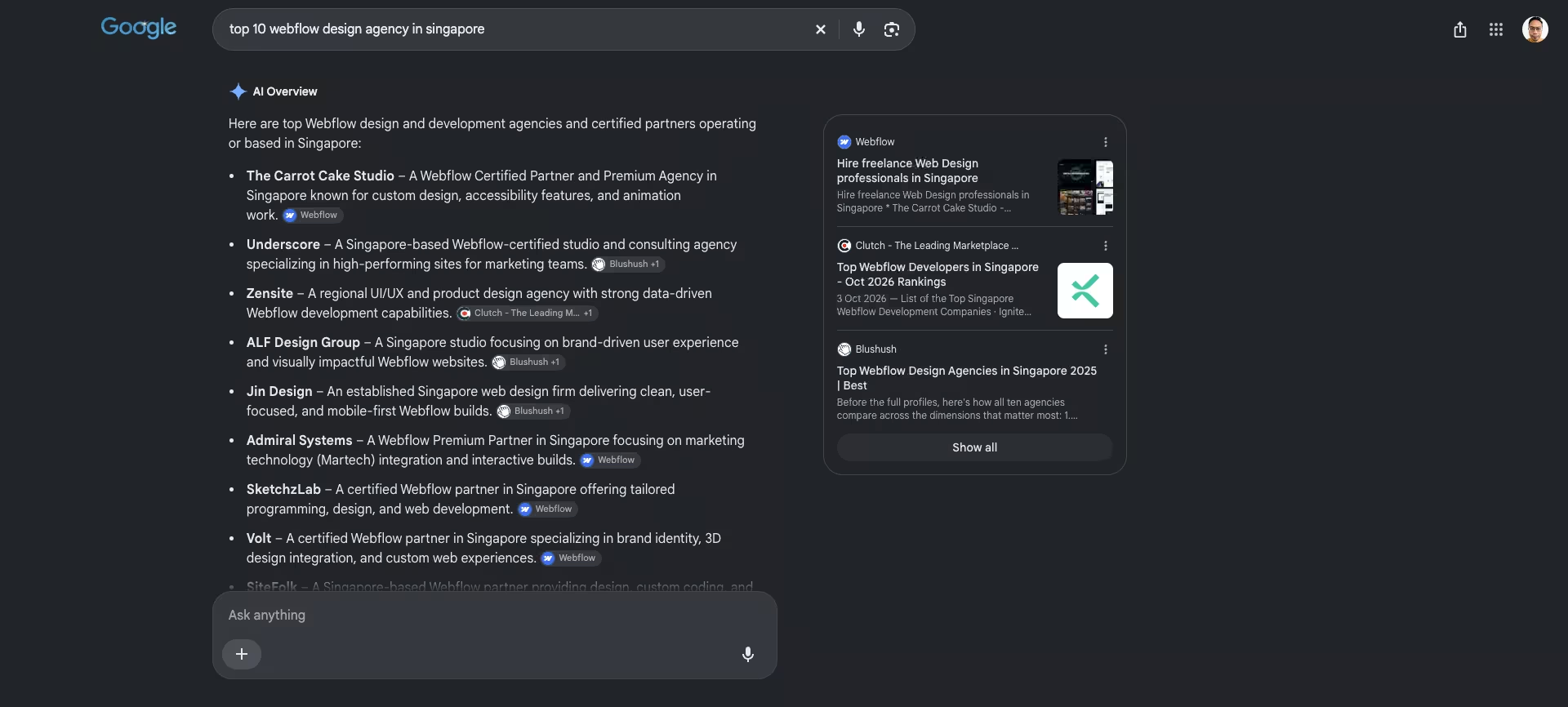
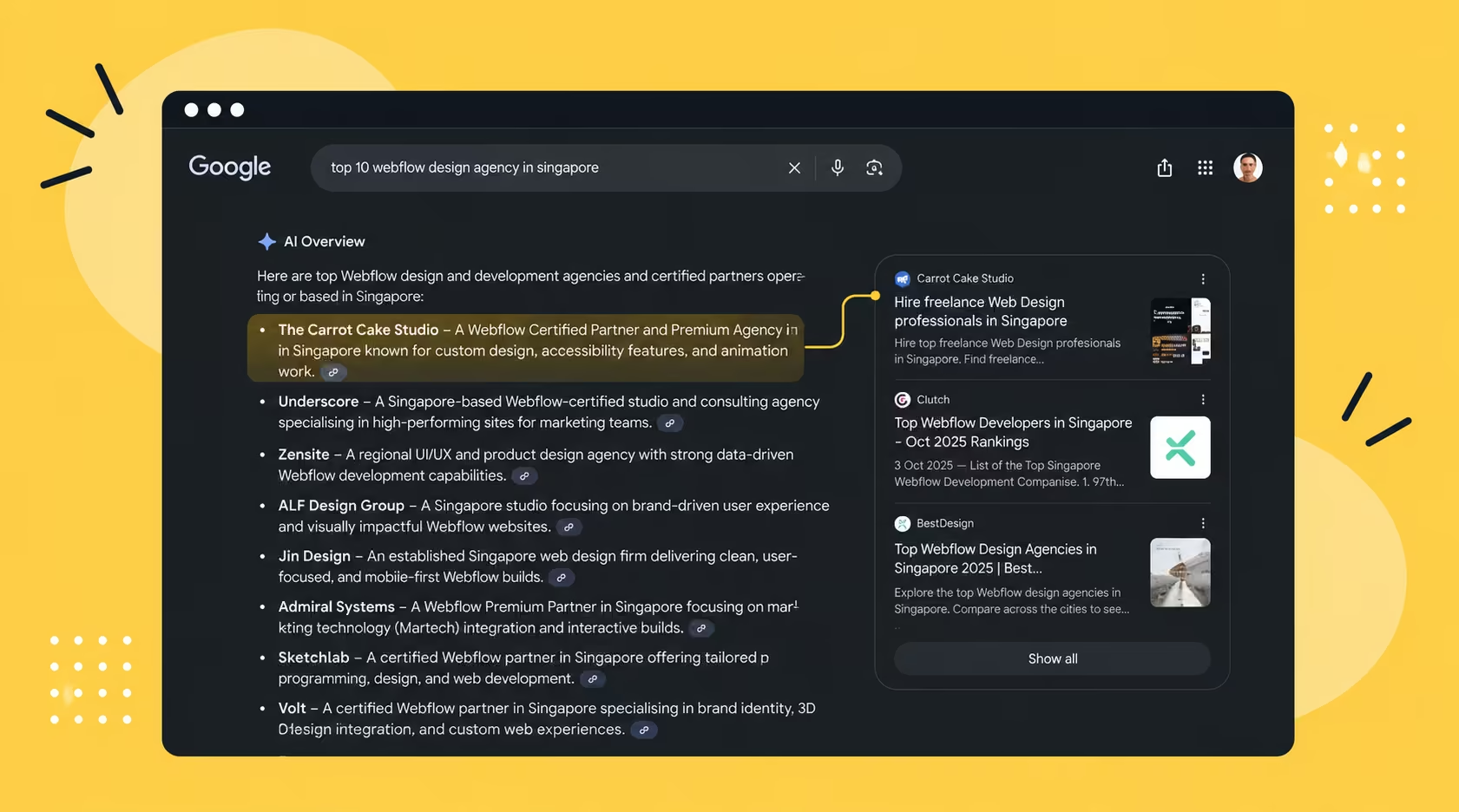
Google AI Overviews are AI-generated summary responses that appear at the top of the search results page for informational and transactional queries. They are produced by Google's Gemini AI model, which synthesises information from multiple sources across the web and presents a coherent answer — with citations to the sources it used.
The journey from SGE to AI Overviews reflects a maturation of the product: what started as an opt-in experiment has become a standard search feature, appearing by default for millions of queries daily. The proportion of queries triggering AI Overviews is highest for informational searches (how-to, what-is, comparison, and recommendation queries) — precisely the types of content that most businesses invest in for top-of-funnel visibility.
For a Singapore business, the practical question is: when someone searches a query relevant to your services, does Google's AI choose your content as one of the sources it cites? That selection is based on specific, learnable signals — not an opaque algorithm that cannot be influenced.
Why AI Overviews Matter for Singapore Businesses
Singapore's digital landscape makes AI Overview visibility particularly high-stakes. Singapore users are mobile-first, query-driven, and accustomed to fast, direct answers. The shift toward AI-generated summaries accelerates a behaviour pattern already present in the market: users want the answer, not the search results page.
According to Gartner's research, search engine volume will decline by 25% by 2026 as users shift toward AI-powered answers. Semrush's traffic data for ChatGPT.com confirms the scale of that shift — AI platforms are now handling a significant and growing share of the queries that previously went to traditional search.
For Singapore businesses in sectors where search is a primary acquisition channel — professional services, financial services, digital services, education, healthcare, property — this means that organic search performance measured purely in SERP positions is an increasingly incomplete picture of digital visibility. AI Overview citations are the new front page.
The Three Places You Can Appear Inside AI Overviews
AI Overviews contain three distinct placement types, each with different characteristics and different optimisation requirements. Understanding all three is essential for maximising visibility within the feature.
1. The core AI Overview summary

This is the primary panel — the boxed, AI-generated answer that appears at the very top of the search results page. When a user's query triggers an AI Overview, this summary is the first thing they see. It synthesises information from multiple sources and presents it as a cohesive answer in Google's own words. Brands cited here gain high-visibility attribution — their name and URL appear as a source within the panel itself.
Earning a citation in the core summary requires the highest standard of content quality: clear, authoritative, directly relevant to the query, structurally clean for machine parsing, and supported by schema markup. The bar is high because Google is staking its own credibility on the sources it cites. Schema implementation is a particularly important enabler here — for the full implementation guide, see our article on how schema markup improves CTR and search visibility.
2. Follow-up queries and conversational mode
After presenting the core summary, Google suggests follow-up queries — the conversational threads that typically follow an initial question. These are powered by Answer Engine Optimisation (AEO): the practice of structuring content to directly answer the follow-up questions users naturally ask within a topic.
For a business to appear in follow-up query citations, its content must address the natural conversational flow around a topic — not just the primary query, but the second and third questions that follow. FAQ sections with specific, substantive answers are particularly effective here. Conversational query structure is covered in depth in our guide on voice search optimisation for AI queries.
3. Cited sources panel
At the bottom or side of each AI Overview, Google displays the specific URLs it used to generate the summary. These are the equivalent of the traditional top organic results — and in many cases they are more valuable, because users who click through from a citation are already primed with the AI's answer and are visiting the cited source to go deeper.
Appearing in the cited sources panel requires strong topical authority, clean technical SEO, and content that is substantively relevant to the query at a depth that goes beyond the AI's summary. A page that merely covers the basics is unlikely to be cited; a page that goes into the detail a curious user would want after reading the summary is far more valuable to Google as a citation.
The Five AI Overview Ranking Factors
AI Overview citation selection operates on different signals from traditional organic ranking. Understanding these factors is the foundation of any optimisation strategy.
1. Entity authority — the primary factor
Google selects sources that it recognises as authoritative entities on the topic in question. An entity, in Google's model, is not just a website — it is a brand with a clearly defined identity, consistent topic associations, and a verifiable presence across multiple signals (website, structured data, mentions in other authoritative sources, consistent authorship).
Building entity authority requires sustained, consistent investment: publishing depth content within a defined topic cluster, using Organisation schema to establish brand identity, ensuring author attribution is clear and consistent, and building the internal linking structure that signals to Google which topics your brand owns. The complete entity-building strategy is covered in our guide on entity-based SEO and topic authority.
2. Topical depth and cluster structure
AI Overviews favours brands with comprehensive coverage of their topic area — not a single article on a subject, but a cluster of interlinked articles that collectively establish mastery. A business with one article on web design and a business with thirty interlinked articles covering every dimension of web design (cost, process, best practices, platform comparison, UX principles, performance) will be treated very differently by Google's citation selection. The latter signals genuine expertise; the former signals a passing mention.
The cluster structure that ALF Design Group has built across its own blog — covering web design, UX, Webflow, SEO, forms, accessibility, responsive design, and conversion — is an example of this principle in practice. The internal links between articles signal to Google that these topics are connected and that the brand has comprehensive expertise across them. For the semantic SEO framework that underpins cluster design, see our guide on semantic SEO explained.
3. Structured data and schema markup
Schema markup makes content machine-readable in the way that AI systems require. Where traditional SEO benefits from schema as an enhancement, AI Overview citation treats it as essential: Google's AI needs to understand with confidence what a page is about, what type of content it contains, who created it, and what specific questions it answers. FAQ schema, Article schema, Organisation schema, and Service schema each contribute to that machine readability in distinct ways.
For the full structured data implementation guide, see our articles on schema markup and CTR visibility and what is structured data and why it matters for SEO.
4. E-E-A-T signals
Experience, Expertise, Authoritativeness, and Trustworthiness — Google's E-E-A-T framework — is directly relevant to AI Overview citation selection. Content that is attributed to named, credentialled authors, supported by real case studies and outcomes, and backed by consistent publication history signals the kind of expertise that Google is willing to cite when generating an AI summary.
In Singapore's regulated industries — financial services, healthcare, legal, property — E-E-A-T signals are weighted particularly heavily. For ALF Design Group's own sector (web design and digital services), E-E-A-T is expressed through client case studies, named authorship, specific project outcomes, and consistent depth of content across the topic cluster.
5. UX performance signals
Google does not cite pages that deliver poor user experiences. Core Web Vitals performance, mobile responsiveness, accessibility, clean semantic HTML structure, and stable layout all contribute to whether a page is considered citation-worthy. A technically weak page — slow loading, layout shifts during load, inaccessible to screen readers — is effectively disqualified regardless of its content quality.
This is where platform choice becomes a direct AI Overview optimisation variable. Webflow's managed hosting on Fastly's CDN, clean semantic HTML output, and first-class responsive design tooling give Webflow-built sites a technical foundation that supports AI Overview visibility by default. For the full picture of how Webflow specifically serves AI SEO, see Webflow for SEO in the AI era.
The Six-Step AI Overview Optimisation Framework
Step 1 — Build a topic cluster around your core service
A topic cluster is a set of interlinked articles that collectively cover a subject from every angle — foundational definitions, how-to guides, comparisons, cost guides, case studies, and specialist sub-topics. The pillar article covers the topic broadly; the cluster articles cover each sub-topic in depth. Internal links between them signal to Google that your brand has comprehensive authority.
For a Singapore web design agency, a cluster might cover: what web design is, how much it costs, how to choose an agency, the design process step by step, platform comparisons, UX best practices, performance optimisation, and accessibility. Each article is distinct; all link to each other. Google sees the cluster as evidence of expertise that goes beyond a single page.
Step 2 — Write AEO-optimised content
AEO (Answer Engine Optimisation) is the practice of structuring content to directly answer the specific questions users bring to a query — in a format that AI systems can extract and cite. Every article should open with a direct answer to its H1 (the exec summary block), include clear H2/H3 definitions that answer sub-questions, and close with an FAQ section that addresses the follow-up questions users most commonly ask.
The exec summary format used throughout ALF's blog — a visually distinct callout block between the H1 and the first H2 that directly answers the article's main question — is specifically designed for AEO. It gives Google a clean, self-contained answer it can use in an AI Overview summary, whilst the full article provides the depth that earns the citation.
Step 3 — Implement comprehensive schema markup
Every published article should carry FAQ schema (delivered as a JSON-LD embed in the page body, not the page head), Article or BlogPosting schema, and breadcrumb schema. Service pages should carry Service schema, LocalBusiness schema, and Organisation schema. HowTo schema should be added to any article with a step-by-step process.
Consistent schema across the site builds a machine-readable knowledge graph that Google can traverse when determining citation authority. A site where every article is schema-marked is significantly more citation-ready than one where schema is applied inconsistently or not at all.
Step 4 — Fix UX and technical performance
Before investing further in content, ensure the technical foundation is citation-ready. Run Google PageSpeed Insights and address any Core Web Vitals failures. Check semantic HTML structure — headings should follow a logical H1 → H2 → H3 hierarchy throughout. Ensure the site is fully mobile-responsive and passes Google's mobile usability test. Fix any accessibility issues that would prevent screen readers from navigating the content correctly.
For a structured technical audit checklist, see our guide on technical SEO maintenance. The UX signals that AI search systems specifically evaluate are covered in top UX signals that influence AI search rankings.
Step 5 — Write for conversational queries
AI Overviews are triggered most frequently by conversational, question-format queries — the type of searches that reflect how people talk to AI assistants. Articles should include conversational H3 subheadings that mirror how users phrase their questions: 'What is the best Webflow plan for a small business?' rather than 'Webflow plan comparison'. FAQ sections should use natural question phrasing. And every article should address the follow-up questions that logically arise after its main topic — not just the top-of-funnel query.
Step 6 — Build entity authority over time
Entity authority is a long game. It is built through consistent publication within a defined topic area, named authorship on every article, case studies that document real outcomes, and a clear Organisation schema that establishes the brand's identity and associations. Mentions in other authoritative publications — trade media, industry directories, partner sites — contribute to the entity signal that Google uses to assess citation worthiness.
For Singapore businesses, local entity signals carry additional weight: Singapore Business Registry information, Google Business Profile completeness, mentions in Singapore-specific publications and directories, and local schema signals all reinforce the entity's geographic relevance for Singapore search queries.
AI Overviews vs Traditional SEO
Singapore Market Impact — Which Sectors Are Most Affected
Finance and investment
Singapore's fintech and investment sector generates a high volume of informational queries — how investment products work, how to compare options, what fees apply, what regulations govern different products. These are precisely the query types that AI Overviews targets. For financial services businesses in Singapore, appearing as a cited source in AI-generated investment and financial planning summaries is a high-value visibility outcome. It requires strong E-E-A-T signals given the YMYL (Your Money, Your Life) classification of financial content, plus comprehensive schema and named authorship from credentialled individuals.
Property and renovation
The Singapore property market drives a constant stream of research-phase queries: renovation costs, HDB regulations, contractor selection, interior design styles. AI Overviews pulls heavily from content that directly answers these research questions with specific, local context. Renovation businesses and property platforms that have invested in comprehensive, Singapore-specific content with clear pricing guides and structured data are well-positioned to earn citations for this query category.
Education and enrichment
Singapore parents search extensively for tuition options, enrichment programmes, international school comparisons, and assessment guidance — all conversational, research-driven queries. The education sector's AI Overview citations will disproportionately favour providers with comprehensive FAQ content, clear programme information structured with schema, and genuine E-E-A-T signals such as tutor credentials and student outcome data.
Web design and digital services
ALF Design Group's own sector is a significant AI Overview opportunity. Queries like 'what does a Webflow agency do', 'how much does web design cost in Singapore', 'what is the best platform for a marketing website', and 'how to choose a UX design agency Singapore' are all AI Overview targets. The investment ALF has made in deep, structured content across web design, UX, Webflow, and SEO clusters positions the agency to earn citations for exactly these queries — which are commercially valuable at the consideration and purchase stage of the buyer journey.
Tools for AI Overview Optimisation
Content and cluster planning
Google Search Console is the starting point — it surfaces the queries your site is currently earning impressions for and the pages driving that traffic. Use it to identify query clusters where you have existing visibility but incomplete content coverage. Semrush and Ahrefs both offer content gap analysis tools that identify topics your competitors are ranking for that you have not yet covered. Frase and SurferSEO can help structure articles to match the depth and format of content currently appearing in AI Overviews for target queries.
Schema and structured data
Schema.org's validator and Google's Rich Results Test both allow you to verify that schema markup is correctly implemented and is being read by Google. For Webflow sites, custom code embeds in the CMS item body are the correct implementation method for FAQ schema — not the page head, which is reserved for page-level schema. Google Search Console's Enhancements reports will show whether your structured data is being indexed correctly and flag any errors.
Performance and technical audit
Google PageSpeed Insights provides Core Web Vitals scores for both mobile and desktop, with specific recommendations for improvement. Screaming Frog or Sitebulb can audit the full site for heading hierarchy issues, broken internal links, missing schema, and accessibility problems. Hotjar or Microsoft Clarity provide behavioural data on how users interact with pages — useful for identifying UX friction points that may be suppressing engagement signals.
Frequently Asked Questions
What are Google AI Overviews and how do they differ from regular search results?
Google AI Overviews are AI-generated summary boxes that appear at the top of the search results page for many queries, presenting a synthesised answer with citations to the sources Google used to generate it. Unlike traditional search results — which list pages in ranked order and require users to click through to find answers — AI Overviews deliver the answer directly on the results page, with cited sources available for users who want to go deeper. For brands, appearing as a cited source in an AI Overview is equivalent to a top-three organic position in terms of visibility, and increasingly more valuable for queries where the AI Overview occupies most of the above-the-fold space.
How does Google decide which sources to cite in AI Overviews?
Google selects citations based on a combination of entity authority (how clearly the brand is associated with the topic), topical depth (whether the site has comprehensive, interlinked content on the subject), structured data quality (how machine-readable the content is), E-E-A-T signals (experience, expertise, authoritativeness, and trustworthiness), and UX performance (whether the page delivers a fast, accessible, stable experience). It is not simply a function of organic ranking position — a page ranked at position eight with strong schema and topical authority may be cited in preference to a page ranked at position two with thin content and no schema.
Is AI Overview optimisation different from traditional SEO?
Yes — significantly. Traditional SEO focuses primarily on keyword targeting, backlink authority, and on-page optimisation to achieve SERP positions. AI Overview optimisation focuses on entity authority, topic cluster depth, structured data completeness, and content that directly answers the specific questions Google's AI is synthesising answers to. Traditional SEO techniques are not wasted — strong organic rankings correlate with AI Overview citation selection — but they are not sufficient alone. The content structure, schema implementation, and entity signals required for AI Overview visibility go beyond what standard SEO practice typically addresses.
How long does it take to appear in AI Overviews?
There is no fixed timeline — citation selection is query-specific and dynamic. However, the pattern observed for sites with strong technical foundations and good content quality is that new, well-structured content begins earning AI Overview citations within two to four months of publication, assuming it addresses a query where the site already has some topical authority. Sites with no existing entity authority in a topic area may take six to twelve months of consistent cluster development before AI Overview citations begin appearing. The timeline is shorter for queries where there are few high-quality competing sources.
Do all queries trigger AI Overviews?
No. Google's AI Overviews currently appear most frequently for informational and research-oriented queries — how-to questions, what-is definitions, comparison queries, and recommendation requests. They appear less frequently for navigational queries (where users are looking for a specific website), pure transactional queries (where users are ready to purchase directly), and queries involving breaking news or rapidly changing information. For most Singapore businesses, the queries most likely to trigger AI Overviews are the informational and consideration-stage queries that sit at the top of the customer research funnel.
Can small Singapore businesses compete for AI Overview citations against large platforms?
Yes — entity authority and topical depth are not solely functions of domain age or overall site size. A smaller business with deeply specialised content in a niche topic area can earn AI Overview citations for queries within that niche even when competing against larger, more broadly authoritative sites. The key is focus: a Singapore UX design agency with comprehensive, structured content across UX design, accessibility, usability testing, and user research will earn citations for UX-related queries more reliably than a large general marketing platform with thin, surface-level coverage of the same topics.
How does Webflow help with AI Overview optimisation?
Webflow supports AI Overview optimisation in several concrete ways. It produces clean semantic HTML that AI systems can parse accurately. Its managed hosting on Fastly's CDN delivers the fast Core Web Vitals scores that Google requires for citation consideration. Its Designer gives teams precise control over heading hierarchy, responsive layout, and accessibility — all of which contribute to technical citation-readiness. And its CMS allows schema markup to be injected per-article via custom code embeds, making FAQ and Article schema implementation scalable across large content libraries. For the full detail, see our guide on Webflow for SEO in the AI era.
Conclusion
Google AI Overviews represents the most significant shift in search behaviour since mobile-first indexing — and for Singapore businesses, the commercial consequences are real and accelerating. The brands that will earn citation visibility in AI-generated answers are those that have invested in genuine topical depth, machine-readable content structure, clear entity signals, and the technical performance that Google requires before it is willing to stake its own credibility on citing a source.
None of these investments are new to good SEO practice. What has changed is their weighting and their urgency. Entity authority, schema markup, and topical cluster depth have moved from 'best practice' to 'threshold requirement' for meaningful visibility in the search results that an increasing proportion of your potential customers will see first.
At ALF Design Group, we help Singapore businesses build the content architecture, technical foundation, and entity signals that earn AI Overview visibility — through Webflow builds that are citation-ready by design, and content strategies grounded in the specific query clusters our clients' customers use. If you want to understand what that looks like for your business, our SEO service is where that conversation starts.
{{build-better-experience="/directory"}}
Resources
Related Articles
Deep dive into our latest news and insights.

.webp)