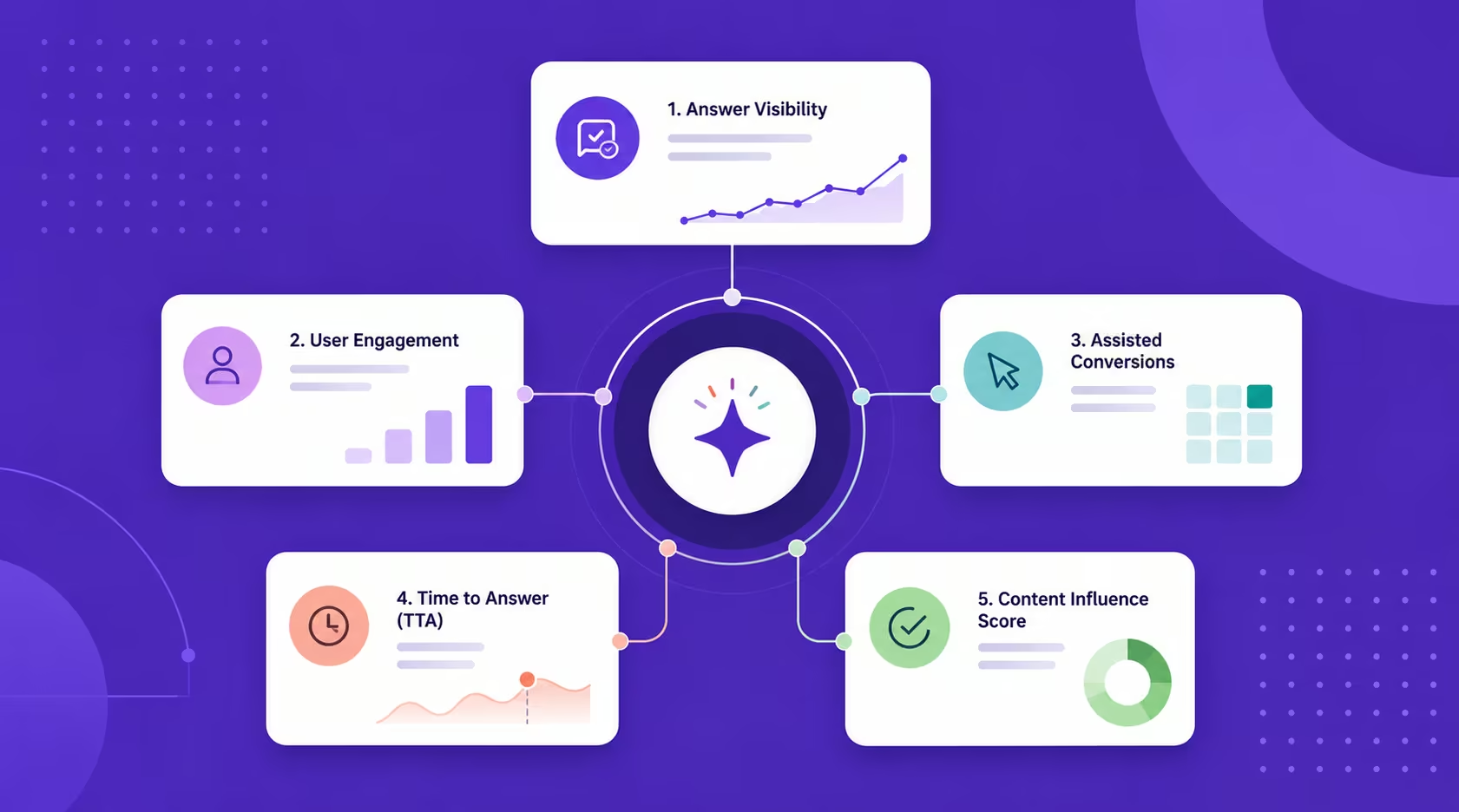
AEO Metrics That Matter: A 5-Metric Framework Beyond Keywords and Rankings
A practical framework for measuring AI visibility, citations, answer ownership and business impact.
Table of contents
Free Website Audit
We'll personally review your website across 6 areas. UX, SEO, performance, mobile, conversion, and send you a detailed, actionable report within 48 hours. No cost. No catch.
SEO still matters. Keywords, rankings, impressions, clicks, technical SEO and backlinks still shape how people discover businesses online. But people increasingly ask ChatGPT, Gemini, Perplexity and Google AI Overviews for direct answers instead of clicking through search results, which shifts the real question from “are we ranking” to “are we part of the answer.” This article gives you a practical 5-metric framework for measuring that shift: AI Answer Visibility, Citation Frequency, Answer Ownership, Intent Coverage and Business Impact.
Why AEO Measurement Matters Now
For years, most businesses measured search through familiar SEO metrics such as keyword rankings, organic traffic, impressions, clicks and backlinks. Those metrics still matter, but AI-assisted search creates a new visibility problem: a user can now ask an AI tool a question and get a direct answer without ever clicking through to a website. If your brand is missing from that answer, you may not even be part of the decision-making moment. For the foundational guide on how to actually appear in AI-generated answers, see our pillar article on how to appear in AI-generated search results.
AI search is also less stable than traditional SEO. Different tools can give different answers, and the same prompt can produce a different response at different times. That makes AEO measurement harder than SEO measurement, which is exactly why you need a practical, repeatable framework rather than a single snapshot. If you want the full picture first, our guide on what AEO is covers the definition and how it relates to the broader shift we explore in how AI is rewriting the rules of search. This article assumes that grounding and focuses purely on how to measure it.
The Problem with Measuring Only Keywords and Rankings
Keywords and rankings are useful, but they do not tell the full story anymore. A keyword ranking tells you where your page appears in a traditional search results page. It does not tell you whether your brand is being included in AI-generated answers. It does not tell you whether an AI tool sees your business as a credible source. It does not tell you whether your competitor is being cited more often than you.
This matters because AI search can influence users before they ever visit your website. For example, someone may ask: “Who are the best web design agencies in Singapore for SMEs?” If your agency is mentioned in the AI answer, that is visibility. If your competitor is mentioned and you are not, that is also a signal.
Another user may ask: “How much does website design cost in Singapore?” This is not the same question. But it still has commercial value. A user asking about market price may be comparing options, planning budget, or preparing to speak to agencies. If your pricing article on website design cost in Singapore is cited in that answer, your brand is influencing the buyer journey earlier. That is why AEO measurement cannot only track one type of prompt. Businesses need to understand how they appear across different types of questions.
What Makes a Website Cite-Worthy?
A cite-worthy page is not necessarily the page with the most content. It is the page that gives the clearest, most specific answer to a real question, which is part of why semantic SEO matters more than ever in 2026 and why building topic authority with entity-based SEO pays off in the AI era. Our guide on what AEO is breaks down what makes content cite-worthy in full. In short, five qualities matter most:
Keep these five qualities in mind as you read the metrics below. Metric 1 (AI Answer Visibility) and Metric 3 (Answer Ownership) are, in effect, measuring how well your content lives up to them, and Strong Structure in particular overlaps with the UX signals that influence AI search rankings.
The 5-Metric Framework for Measuring AEO
Because AEO measurement is still evolving, businesses should not wait for one perfect tool. Instead, start with a practical framework. The goal is to understand whether your brand is appearing, being cited, being preferred, covering the right intents and influencing business outcomes. Here are the five metrics that matter.
Metric 1 — AI Answer Visibility
AI Answer Visibility measures whether your brand appears in relevant AI-generated answers. This is the most basic AEO metric. If users ask AI tools questions related to your industry, services, category or expertise, does your brand show up?
For example, ALF Design Group might want to test prompts such as: “Best web design agency in Singapore for SMEs”, “Who is good at Webflow development in Singapore?”, “Which UX agency in Singapore works with business websites?”, “What agencies in Singapore write useful content about AEO?”, “Which company explains website maintenance clearly?”
These are not traditional keywords. They are answer-seeking prompts. The goal is to understand whether your brand appears when the user is looking for recommendations, explanations or comparisons.
How to Measure AI Answer Visibility
Start by building a fixed set of prompts. Run those prompts across tools such as ChatGPT, Gemini, Perplexity and Google AI Overviews. According to Google’s own documentation on AI features in search, AI Overviews appear for an increasing share of queries, making this measurement increasingly important.
Then record: Did your brand appear? Where did it appear? Was it mentioned directly? Was it mentioned with competitors? Was it recommended? Was it absent? Did the answer mention your website or only your brand? Did the answer cite a specific page?
You can score this simply. For example:
- 0 = not mentioned
- 1 = mentioned briefly
- 2 = listed with competitors
- 3 = recommended as a strong option
- 4 = singled out with supporting explanation
This does not need to be perfect at the beginning. It needs to be consistent. Measure the same prompt set regularly so you can observe movement over time.
Metric 2 — Citation Frequency
Citation Frequency measures how often your pages are cited, linked or referenced in AI-generated answers. This is different from brand visibility. Your brand may be mentioned without a citation. Or your page may be cited as a source for a specific answer. Both matter, but citations are especially important because they show that your content is being used as source material.
For example, if an AI tool answers “How much does website design cost in Singapore?” and cites your pricing article, that is valuable. It means your content is not only visible. It is being used to support the answer.
How to Measure Citation Frequency
Track whether AI tools cite your homepage, service pages, blog articles, pricing guides, case studies, FAQ pages, comparison pages, glossary pages, and research-led content. Then record how often each page appears. Over time, you may discover that certain pages are more cite-worthy than others.
For example, practical guides, pricing explainers, comparison articles and FAQ-led content may be more likely to appear because they answer specific questions clearly. This gives you useful content strategy insight. If one article is repeatedly cited, you may want to strengthen it, update it and link it to related commercial pages. If a key service page is never cited, you may need to improve its clarity, structure and usefulness.
Metric 3 — Answer Ownership
Answer Ownership measures whether your brand is being singled out as a strong answer, not merely included in a list. This is where AEO becomes more interesting. Appearing is good. Being cited is better. But being recognised as the best or most relevant answer is stronger.
For example, if an AI tool lists ten web design agencies in Singapore and your brand appears in ninth position with no explanation, that is weak visibility. If the AI answer says your agency is particularly useful for Webflow, UX-led web design or SME websites, that is stronger answer ownership. The goal is not only to appear. The goal is to understand how you are being positioned.
How to Measure Answer Ownership
Look at how AI tools describe your brand. Ask: Are we recommended or merely mentioned? Are we positioned correctly? Are we associated with our core services? Are we being compared favourably? Are competitors being singled out instead? Are we being described accurately? Are we appearing for the right reasons? Are we being treated as a thought leader?
This metric is partly quantitative and partly qualitative. You can count how often your brand appears, but you also need to read the answer. For AEO, sentiment and positioning matter. If an AI answer mentions your brand but associates it with the wrong service, wrong audience or outdated information, that is not ideal. Answer ownership is about whether AI systems understand your brand in the way you want to be understood.
Metric 4 — Intent Coverage
Intent Coverage measures whether your brand appears across different types of user questions. This is important because users do not only ask one type of question.
One user may ask: “Best Webflow agency in Singapore”. Another may ask: “How much does Webflow development cost in Singapore?” Another may ask: “Is Webflow good for SEO?” Another may ask: “Should SMEs use Webflow or WordPress?” Another may ask: “What should I prepare before hiring a web design agency?”
All of these prompts can have business value, but they represent different stages of the buyer journey. Some are educational. Some are comparison-based. Some are pricing-related. Some are commercial. Some are transactional. If your brand only appears for educational questions but not commercial ones, your AEO visibility may not translate into enquiries. If your brand appears for service recommendations but not pricing or comparison questions, you may be missing earlier decision moments.
How to Measure Intent Coverage
Group your prompts into categories. For example:
- Educational intent: “What is AEO?”, “Does web design include SEO?”, “What is Webflow CMS?”, “Can ChatGPT build me a website?”
- Comparison intent: “Webflow vs WordPress for Singapore SMEs”, “AI website builder vs web design agency”, “Cheap web design vs strategic web design”
- Pricing intent: “How much does website design cost in Singapore?”, “What is the average price of Webflow development?”, “How much should SMEs budget for website maintenance?”
- Commercial intent: “Best web design agency in Singapore”, “Best Webflow agency for SMEs”, “UX design agency in Singapore for business websites”
- Transactional intent: “Hire Webflow agency Singapore”, “Website redesign agency Singapore”, “Website maintenance support Singapore”
Then measure whether your brand appears across each intent group. This gives you a more complete view of AEO performance. It also helps your content strategy. If you are missing from pricing prompts, create clearer pricing content. If you are missing from comparison prompts, build stronger comparison articles. If you are missing from commercial prompts, strengthen service pages, case studies and third-party brand signals. For example, an article like “Can ChatGPT build me a website?” speaks to educational intent and helps surface ALF inside AI-prompted exploration moments.
Metric 5 — Business Impact
Visibility alone is not enough. AEO still needs to connect back to business outcomes. Business Impact measures whether AI visibility is contributing to meaningful results. This is the hardest metric, but it is also the most important.
AEO may not always produce direct clicks. Sometimes the value is indirect. A user may discover your brand in an AI answer, then search your brand later. They may visit your website directly. They may ask around. They may compare you with competitors. They may return later through Google, LinkedIn or a referral. This makes attribution messy. But messy does not mean meaningless.
How to Measure Business Impact
Businesses can start by tracking: AI referral traffic, branded search growth, direct traffic changes, enquiry volume, lead quality, assisted conversions, contact form submissions, WhatsApp enquiries, “How did you hear about us?” responses, pages visited before enquiry, and increased demand for specific services.
For example, if your AEO content improves and you begin seeing more branded searches for your agency, that may suggest stronger brand discovery. If users start enquiring about services mentioned in your AI-visible content, that may be another signal. If your pricing guide is cited more often and enquiries become more qualified, that may indicate business impact.
The key is to avoid measuring AEO in isolation. AEO visibility should eventually support brand demand, trust and enquiries. This is exactly why SEO and UX must work together to build a website that ranks and converts, AEO visibility without UX and conversion thinking just creates traffic, not business outcomes.
How SMEs Can Start Measuring AEO Without Expensive Tools
Not every business needs an advanced AEO dashboard from day one. Tools can help. Platforms such as Ahrefs and newer AI search visibility tools can support tracking, monitoring and reporting. There are also emerging tools designed specifically to monitor AI mentions, citations and prompt visibility. But for budget reasons, many SMEs can start manually. Manual tracking is not perfect, but it is useful. Here is a simple way to begin. For the structured audit approach that complements ongoing measurement, see our AI SEO audit checklist for 2026.
Step 1 — Create a Prompt Set
Start with 20 to 50 prompts related to your business. Include different intents: educational, comparison, pricing, commercial, transactional. Make the prompts realistic. Use the kind of questions your customers might actually ask.
Step 2 — Test Across Multiple Platforms
Run the prompts across tools such as ChatGPT, Gemini, Perplexity and Google AI Overviews where available. Do not rely on one platform only. Different AI systems may retrieve, summarise and cite sources differently.
Step 3 — Record Mentions and Citations
Create a simple spreadsheet. Track: prompt, platform, date, did your brand appear, was your website cited, which page was cited, which competitors appeared, how were you described, was the answer accurate, was your brand recommended, was there a clear citation.
Step 4 — Repeat Monthly
Do not test once and assume the result is final. AI answers can change. Measure repeatedly so you can observe patterns. The goal is not to obsess over one result. The goal is to understand whether your visibility is improving over time.
Step 5 — Connect Findings to Content Strategy
Use the data to guide what you create next. If you are not appearing for pricing questions, create pricing explainers. If you are not appearing for comparison questions, create comparison content. If competitors are being cited more often, review what makes their pages clearer or more authoritative. If your brand is mentioned but not positioned correctly, improve your service pages, About page, case studies and topical content. AEO measurement should lead to action.
Why FAQ-Led Content Works for AEO
FAQ-led content is becoming more valuable because it mirrors how users ask questions. In traditional SEO, many businesses created articles around keywords. In AEO, businesses need to think more deeply about questions. What is the user asking? What answer do they need? What context helps them make sense of the answer? What follow-up questions will they likely ask?
This is why each heading should have an answer. A good AEO article is not just a long article. It is a structured answer system. For example, instead of writing a vague heading like “Understanding Website Performance”, a clearer AEO-friendly heading might be “Why Is My Website Getting Traffic But No Leads?” That heading reflects a real user question. The section should then answer it directly.
FAQ-led structures also help break complex topics into smaller, more extractable answers. This makes the content easier for humans to read and easier for AI systems to interpret. But again, structure alone is not enough. The answer still needs expertise.
What Businesses Should Not Do When Measuring AEO
AEO measurement is useful, but it can also be misunderstood. Here are a few mistakes to avoid.
Do Not Measure One Prompt Once
One prompt result is not enough. AI answers can vary across time, tools and phrasing. If you measure once, you may get a misleading snapshot. Track prompt sets repeatedly.
Do Not Only Measure Brand Mentions
Being mentioned is useful, but it is not the full story. You also need to know whether your pages are cited, whether your brand is recommended, whether competitors appear more often, and whether the visibility leads to business outcomes.
Do Not Chase AI Visibility Without Improving Content
If your pages are thin, generic or unclear, measurement alone will not help. AEO measurement should lead to better content, stronger structure and clearer answers.
Do Not Forget SEO
AEO does not replace SEO. If your website has poor SEO foundations, weak technical structure, no topical authority and unclear pages, AEO will be harder. For the bigger picture of where SEO is heading, see the future of SEO for businesses in Singapore.
Do Not Pretend Attribution Will Be Perfect
AI search can influence a user before they ever visit your website. Some impact may show up through branded search, direct traffic, referral traffic, assisted conversions or better-qualified enquiries. Attribution may not be clean. That does not mean the influence is not real.
How AEO Changes the Role of Content Strategy
AEO forces businesses to ask a harder question: “Are we actually useful enough to be included in the answer?” This changes content strategy. It is no longer enough to publish articles that target keywords. Businesses need content that answers real questions clearly, demonstrates original expertise and builds topical authority.
For example, a web design agency in Singapore should not only publish articles such as “Web Design Singapore”. It should also answer questions such as: How much does website design cost in Singapore? Does web design include SEO? Why is my website not generating leads? Can ChatGPT build me a website? Cheap web design vs strategic web design: which should SMEs choose? What happens after a website goes live? How should businesses measure AEO?
Each of these questions reflects a real concern. Each article helps build a larger answer ecosystem. Over time, that ecosystem helps search engines, AI tools and users understand what the brand is known for. That is the real value of AEO content. It is not one article. It is the accumulated clarity of your expertise.
Frequently Asked Questions
What counts as a good AI Answer Visibility score?
There is no universal benchmark yet, because AI answer behaviour is still too inconsistent across platforms and prompts. A more useful goal is relative: track your own score over time and aim for steady upward movement, and check where you sit against named competitors on the same prompt set. Consistently scoring a 3 or 4 on the prompts that matter commercially to your business is a strong signal, even if you are not appearing on every single prompt you test.
What does it cost to start tracking AEO metrics?
Very little to start. Manually running a prompt set across the free tiers of ChatGPT, Gemini and Perplexity, and logging results in a spreadsheet, costs nothing beyond the time it takes. Paid AI visibility tools exist and can save time once you are tracking dozens of prompts regularly, but they are worth adding later, not a requirement to begin.
Which metric should I prioritise first if I cannot track all five at once?
Start with AI Answer Visibility. It is the simplest to measure, it tells you immediately whether you are in the conversation at all, and it is the input every other metric builds on: you cannot measure citation frequency or answer ownership for a brand that is not appearing in the first place. Add Citation Frequency next once you have a baseline.
Does a low score when I start out mean my content strategy is wrong?
Not necessarily. A low first score is common, especially for newer content or a competitive category, and on its own it just tells you where you are starting from. It becomes a real signal once you have measured a few times and the score is not moving, at which point it is worth revisiting the content itself rather than the measurement process.
Can I use this framework to benchmark competitors, not just my own brand?
Yes, and it is one of the more useful ways to use it. Run the same prompt set and score competitors the same way you score your own brand. Seeing that a competitor is consistently recommended while you are only listed alongside them tells you something a rankings report never will.
Conclusion
AEO measurement is still evolving, and there is no single dashboard yet that captures every mention, citation and business outcome. Start anyway. The brands that begin tracking now will likely have stronger content and stronger visibility by the time the tools mature.
Start with whichever metric is easiest for you to track this month: run a small prompt set across ChatGPT and Gemini, or audit which of your existing pages already get cited. Then build a simple habit around it. Repeat the same prompt set monthly, connect what you find back to your content plan, and keep refining until your brand deserves to be part of the answer.
If you are thinking about how SEO, AEO and content structure should work together for your website, get in touch. My team and I help businesses build content ecosystems that are measured for both search rankings and AI-generated answers.
{{build-better-experience="/directory"}}
Written By
.webp)
Resources
Related Articles
Deep dive into our latest news and insights.