The State of Web Design in 2026
The key web design trends, tools, and strategic shifts that matter most for businesses and designers in 2026.
Table of contents
Free Website Audit
We'll personally review your website across 6 areas. UX, SEO, performance, mobile, conversion, and send you a detailed, actionable report within 48 hours. No cost. No catch.
Web design in 2026 has moved past its disruptive phase into a settled maturity — speed, AI-assisted workflows, and intentional UX are now the baseline expectation, not a competitive edge. The shift shows up in three structural changes: Webflow has become the default platform for professional Singapore builds, accessibility has merged with SEO as a single technical discipline, and Answer Engine Optimisation has emerged alongside traditional SEO as AI-driven search reshapes discovery. For Singapore businesses, the practical implication is that visual polish alone no longer differentiates — the sites winning are those treating design as a strategic, continuously measured investment rather than a one-off project.
Where Web Design Stands as We Enter 2026
Looking back at where the industry was just two years ago, the pace of change has been remarkable. In 2024, AI design tools were largely experimental. No-code platforms were growing but still considered niche. Accessibility was treated as a compliance exercise rather than a design discipline. And most businesses were still measuring website success by traffic alone.
In 2026, all of that has shifted. AI is embedded in everyday design workflows. Webflow and its counterparts have become the default choice for professional web builds across Singapore's SME sector. Accessibility is increasingly tied to SEO performance and brand reputation. And smart businesses are measuring website success by conversion quality, engagement depth, and revenue contribution — not just visitor numbers.
The conversation has matured, and so have the expectations on both sides: users are more discerning, and the businesses investing in design are more strategic.
For the foundational principles behind all of this — the practices that hold regardless of which platform or trend shifts next — see our guide on web design best practices.
AI Has Matured from Hype into a Genuine Design Workflow Tool
AI Is Now Part of the Design Stack — Not a Separate Experiment
The first generation of AI design tools arrived with enormous expectations and, frankly, mixed results. In 2026, the second generation is delivering. AI assistance is now deeply embedded in how professional design teams research, ideate, prototype, and iterate.
Figma's State of the Designer 2026 report, surveying over 900 designers globally, found that 72% now use generative AI in their workflow — and notably, 91% say it's improving the quality of their output, not just their speed."
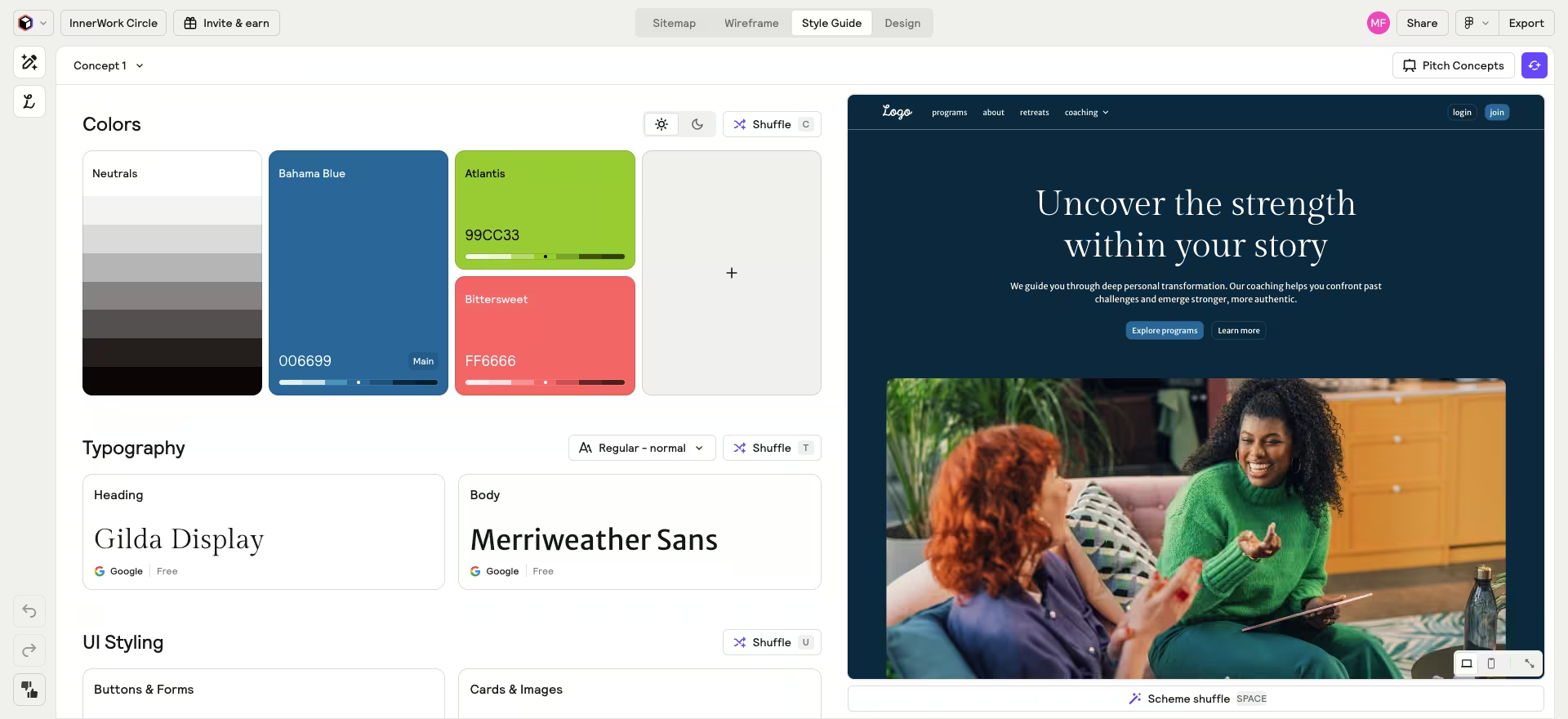
Figma's AI features have moved well beyond autocomplete — they now support layout generation, accessibility checking, localisation previews, and copywriting directly within the design canvas. Tools like Midjourney and Adobe Firefly are used routinely for concept exploration and visual direction validation before a single wireframe is drawn. And AI-powered writing assistants help design teams draft microcopy, headings, and CTA variations at speed.
The practical effect on timelines is significant. Processes that previously took days — such as generating multiple homepage concepts for client review — now take hours.
This frees senior design thinking for where it matters most: strategy, user research, and nuanced decision-making.
What AI Still Cannot Do
Despite its progress, AI has real and important limitations in 2026. It cannot interpret the cultural nuance that makes a website resonate with a Singaporean audience differently from one targeting, say, a European or North American market. It cannot sit in a UX workshop and sense the tension in the room when stakeholders disagree about a product's value proposition. And it cannot make the kind of holistic judgement calls that experienced designers make when trade-offs are required between aesthetics, performance, and business goals.
At ALF Design Group, we treat AI as a capable assistant — not an autonomous designer. Our UX strategy and workshop process remains human-led, because tools do not understand your users the way people who have spoken to those users do.
Webflow's Position in 2026 — From Agency Favourite to Business Standard
The No-Code Platform Has Reached Mainstream Adoption
When we wrote about why businesses prefer Webflow for website design, the argument was still partly aspirational for some clients. In 2026, that conversation is largely settled. Across Singapore's SME sector — from fintech and SaaS to professional services and e-commerce — Webflow has become the default choice for businesses that want a high-quality, maintainable, and performant website without the overhead of a traditional development build.
The reasons are well established by now: visual design flexibility without sacrificing clean code, a powerful CMS that empowers marketing teams to publish and update content independently, strong native SEO controls, and seamless responsiveness across devices.
But 2026 has brought meaningful new capabilities that have strengthened the platform's position further.
What Is New in Webflow in 2026
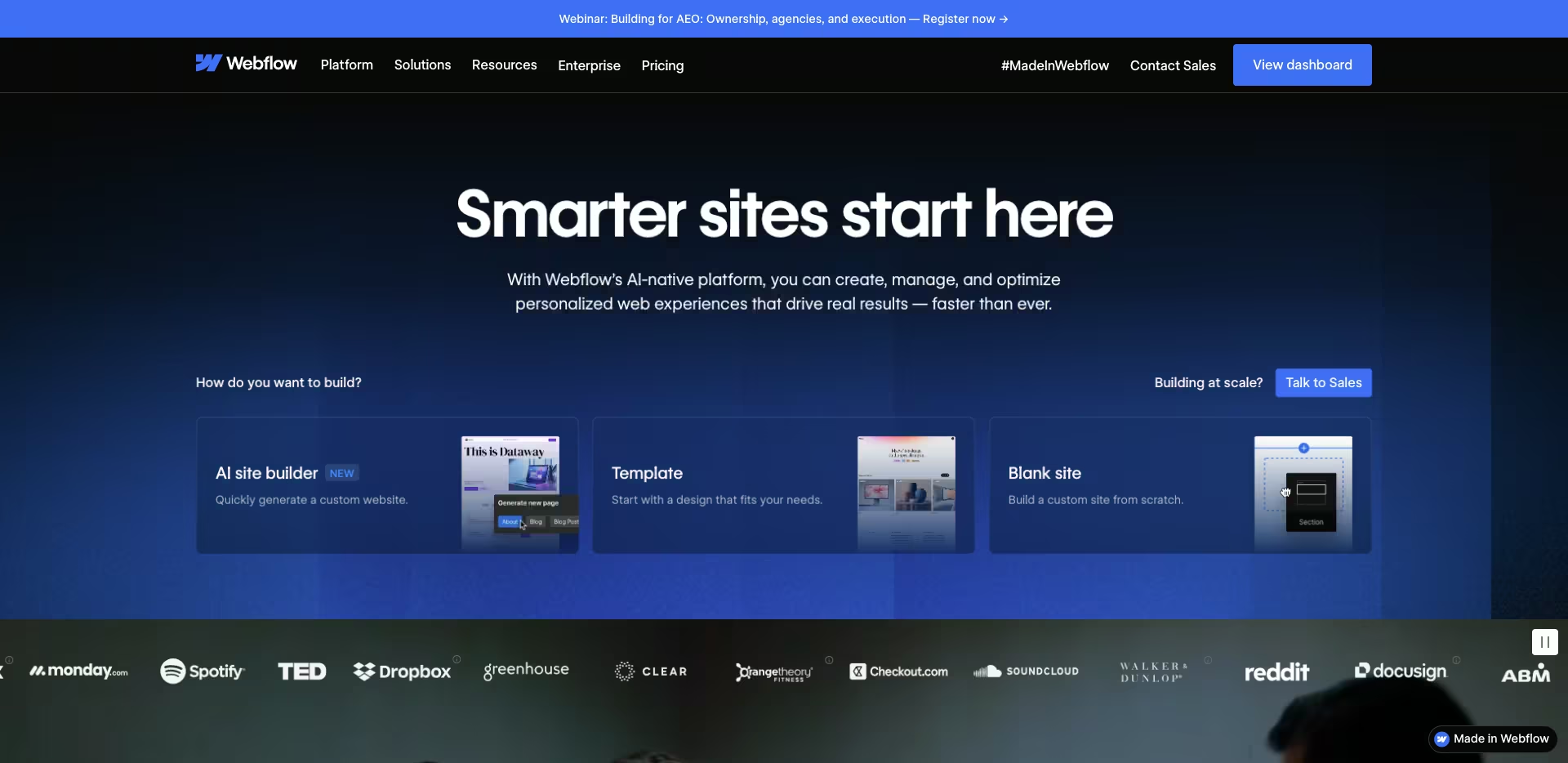
Several developments are shaping how teams use Webflow today:
Webflow Optimize — now more widely adopted — enables native A/B testing and personalisation without requiring third-party tools. This is particularly valuable for Singapore businesses that want to test different messaging, CTAs, or layouts for different audience segments without adding complexity to their tech stack.
AI-powered content generation is now built into the Webflow CMS editor, allowing non-technical team members to draft and refine copy within the platform itself.
Enhanced schema and structured data controls make it easier to implement the technical SEO and AEO requirements that are increasingly important for search visibility in an AI-driven search landscape.
Webflow's expanded marketplace of integrations now connects seamlessly with the CRM, analytics, and marketing automation platforms that most Singapore businesses rely on — reducing the friction of a previously fragmented toolset.
For businesses still on WordPress, custom-built legacy platforms, or drag-and-drop site builders, the gap between those platforms and Webflow has widened considerably. If a migration conversation has been deferred, 2026 is the year to have it seriously.
Related reading: Why SEO and Marketing Teams Recommend Webflow
Performance-First Design Is the New Baseline
Core Web Vitals Are Now Table Stakes
Google's Core Web Vitals — measuring Largest Contentful Paint (LCP), Interaction to Next Paint (INP), and Cumulative Layout Shift (CLS) — have been ranking signals for several years now. In 2026, they are no longer a differentiator; they are a baseline requirement. Websites that fail Core Web Vitals thresholds are not just losing rankings — they are losing users who have simply become conditioned to expect instant, smooth web experiences.
In Singapore, where mobile usage exceeds 90% of browsing sessions for many business categories and 4G/5G connectivity is ubiquitous, slow websites are particularly punishing. Users here are accustomed to the speed of apps like Grab, Shopee, and banking platforms — and they apply those expectations to every web experience they encounter.
What Performance-First Design Looks Like in Practice
Performance-first design in 2026 means embedding performance decisions into the design brief, not the development QA checklist:
- Images planned for WebP or AVIF format with defined compression targets from the outset
- Animation and interaction decisions made with load impact in mind, avoiding heavy libraries where native CSS can achieve the same result
- Third-party script audits conducted before launch, not after performance issues emerge
- Mobile breakpoints designed and tested on real devices, not just browser emulators
- Platforms like Webflow used precisely because they produce standards-compliant, well-optimised code by default
At ALF Design Group, performance is not a technical afterthought — it is part of every project brief. A website that looks exceptional but responds slowly is not finished. It is a liability.
Read more: How to Optimise Your Website's Speed
UX Strategy Has Become the Primary Competitive Differentiator
Visual Design Is Necessary but No Longer Sufficient
For much of the past decade, "great web design" was largely defined by visual quality. In 2026, visual quality is the entry price — not the differentiator. The businesses winning online are those that have invested in UX strategy: understanding what their users need at each stage of the journey, removing the friction that prevents them from acting, and measuring outcomes so that improvements are grounded in evidence rather than intuition.
The shift is visible in how clients approach us at ALF. Five years ago, a brief typically led with aesthetics: "we want a modern, premium-looking website." Today, it leads with outcomes: "we need more qualified enquiries," "our checkout abandonment is too high," or "users are not converting on mobile." These are UX briefs, even if clients do not always use that language.
UX Research Has Become Accessible to Businesses of All Sizes
The tools that power serious UX research — heatmaps, session recordings, funnel analytics, A/B testing — have become considerably more accessible and affordable in recent years. Microsoft Clarity is free. Hotjar's entry tier is modest. Webflow Optimize is included in higher-tier plans.
This means that even Singapore SMEs without dedicated UX teams can now gather meaningful behavioural data about how their users interact with their website — and act on it. The barrier is no longer the tools; it is knowing what questions to ask and how to translate the answers into design decisions.
This is where experienced UX design agencies add genuine value: not just in building the website, but in interpreting the data and driving continuous improvement after launch.
Read more: How UX/UI Can Improve Your Website's Conversions
Read more: How to Increase User Engagement on a Website
Accessibility Is Now Directly Tied to SEO and Brand Reputation
The Regulatory and Commercial Case Has Strengthened
Accessibility has historically been treated as a compliance exercise — something you do to avoid legal exposure. In 2026, that framing has largely been displaced by a more sophisticated understanding: accessible design is simply better design, and the commercial case for it is now well established.
WCAG 2.2, which introduced new criteria around focus indicators, minimum target sizes for interactive elements, and improved support for users with cognitive disabilities, is now the working standard across the industry. In Singapore, GovTech's Digital Service Standards (DSS) — aligned to WCAG — set the accessibility benchmark for government digital services, and the expectation is progressively extending to private sector platforms.
The SEO and Performance Connection
What has become clearer in 2026 is the direct relationship between accessibility and search performance. Accessible websites rely on semantic HTML structure, clear heading hierarchies, properly labelled interactive elements, and descriptive alt text for images. These are also exactly the signals that search engines use to understand, index, and rank content.
In other words, a website built to WCAG 2.2 AA standards is, almost by definition, better positioned for search than one that is not. The two disciplines have converged, and teams that treat them separately are working harder than they need to.
Read more: Improve Website Accessibility Without Compromising Design
SEO in 2026 — The Age of AEO and Generative Search
AI-Driven Search Has Changed the Rules
Perhaps no area of web design strategy has changed more dramatically than SEO over the past 18 months. Google's AI Overviews, Perplexity, ChatGPT Browse, and similar tools are now a significant part of how users find and consume information online. The traditional model — optimise for keywords, rank in the top 10, receive clicks — has been supplemented by a newer dynamic: surface your content in AI-generated summaries, or risk being invisible to the growing proportion of users who never scroll past the answer.
This has given rise to Answer Engine Optimisation (AEO): the practice of structuring content so that AI-driven search tools can surface it confidently in response to user queries. It requires clear, well-structured content with proper heading hierarchies, FAQ sections, schema markup, and a distinct point of view that AI systems can attribute and cite.
What AEO Means for Your Website
For Singapore businesses, AEO in 2026 means:
- Writing content that directly and clearly answers the questions your target users are asking
- Using structured data (JSON-LD schema) to help AI systems understand the context and authority of your content
- Building topic depth around your core service areas, not just individual keyword-optimised pages
- Establishing your brand as a citable entity through consistent, well-referenced content across your site and external platforms
At ALF Design Group, every new website we build now includes structured data as a standard deliverable — not an optional add-on. The same goes for FAQ sections on key service and blog pages, which continue to perform well both in traditional search results and AI-generated summaries.
Read more: How Schema Markup Improves CTR and Search Visibility
Read more: SEO and UX: How to Build a Website That Ranks and Converts
What Singapore Businesses Should Prioritise in 2026
For the specific visual and interaction-level trends shaping individual design decisions this year — typography, motion, personalisation UI patterns — see our web design trends guide. What follows here is the strategic layer: the priorities that matter regardless of which visual trends you adopt."
Based on our work with clients across Singapore and Southeast Asia, these are the highest-impact priorities for web design and digital strategy in 2026:
Strategy before screens. Define your user personas, conversion goals, and success metrics before any visual design begins. The businesses that struggle are almost always those that skipped this step.
Move to a platform that gives your team independence. If your marketing team cannot update your own website without filing a developer ticket, you are operating at a significant disadvantage. Webflow solves this.
Design for mobile as the primary experience. With mobile sessions dominating most Singapore business websites, every design decision must be validated on real mobile devices — not scaled down from a desktop layout.
Embed performance into your design brief. Speed is not a technical problem to solve after launch. It is a design discipline to apply from the start.
Make accessibility non-negotiable. WCAG 2.2 AA compliance is now the sensible standard. The cost of retrofitting accessibility is always higher than building it in from the beginning.
Invest in AEO alongside traditional SEO. Structure your content for AI-driven search. Use schema markup, FAQ sections, and clear heading hierarchies across your site. Build topical depth, not just keyword coverage.
Measure continuously and iterate. Launch is not the finish line. Set up heatmaps, conversion tracking, and regular analytics reviews. The websites performing best in Singapore in 2026 are those being actively managed and improved — not published and forgotten.
Frequently Asked Questions
How often should a Singapore business update or redesign its website?
Most businesses benefit from a meaningful UX review every 12 to 18 months. A full strategic redesign is typically warranted every 3 to 4 years, or when significant business changes occur — entering a new market, shifting the target audience, or rebranding. Beyond redesign cycles, content updates, performance monitoring, and incremental UX improvements should be ongoing.
Is it too late to invest in web design if my business has been slow to modernise?
No — but the gap is compounding rather than static. Businesses that haven't updated their platform, performance, or accessibility standards in the last few years aren't just behind on aesthetics; they're behind on the technical baseline that search engines and users now expect by default. The good news is that catching up on fundamentals — platform, speed, accessibility — tends to produce a bigger and faster improvement than chasing whatever is newest, precisely because so many sites are still missing the basics.
Does investing in web design maturity actually show up in measurable business results, or is it mostly a brand exercise?
It shows up in measurable results, and increasingly in ways that are easy to track. Performance improvements affect both rankings and conversion rates directly. Accessibility fixes expand the pool of users who can actually use your site. AEO-ready content becomes citable in AI-generated answers, which is a newly measurable channel in its own right. The businesses treating this as a brand exercise tend to under-invest in the parts — speed, structure, measurement — that actually move the numbers.
Does AI reduce the need for a professional web design agency?
It changes what an agency spends its time on, rather than removing the need for one. AI has absorbed a lot of the production-level work — generating concepts, drafting copy variations, speeding up prototyping — which means agencies now spend proportionally more time on strategy, research, and the judgement calls AI can't make on its own. For a business hiring an agency in 2026, that's actually a better trade: less time and cost spent on production, more spent on the decisions that determine whether the site performs.
My website already ranks well in Google — do I still need to worry about AEO?
Yes, because ranking in traditional search results and being cited in AI-generated answers are increasingly two separate outcomes. A page can rank on page one and still never get surfaced when the same query is asked through an AI Overview or an AI assistant, because those systems select content based on structure and clarity, not just authority. If a meaningful share of your target audience is using AI-driven search tools — and that share is growing — traditional rankings alone won't guarantee visibility in that channel.
If I can only prioritise one or two things from this list in 2026, what should they be?
Performance and accessibility, in that order, if resources are limited. Both are foundational rather than optional in 2026 — a slow or inaccessible site undermines every other investment you make, including AEO and UX strategy, since none of that matters if users or AI systems can't load or parse the page properly. Everything else compounds on top of those two once they're solid.
Conclusion — Web Design in 2026 Is a Strategic Investment, Not a Creative Exercise
The state of web design in 2026 reflects an industry that has grown considerably more sophisticated. The most successful websites are not the ones with the largest budgets or the most elaborate animations — they are the ones built on a clear understanding of the user, optimised for speed and accessibility, structured for AI-driven search, and actively managed after launch.
For Singapore businesses operating in a competitive, mobile-first, digitally mature market, the website is not a brochure. It is a revenue-generating asset that deserves ongoing investment, measurement, and strategic attention.
At ALF Design Group, this is the standard we hold ourselves and our clients to on every project. If you are ready to build a website that performs in 2026 — not just one that looks good at launch — we would love to talk.
{{build-better-experience="/directory"}}
Categories
Written By
.webp)
Resources
Related Articles
Deep dive into our latest news and insights.