What Is UX Research? A Guide for Singapore Businesses
What UX research is, what it tells you about your customers, and how it shapes your website or app.
Table of contents
Free Website Audit
We'll personally review your website across 6 areas. UX, SEO, performance, mobile, conversion, and send you a detailed, actionable report within 48 hours. No cost. No catch.
UX research is the work of finding out what your customers look for and what they actually do. It then checks those findings against your business goals. It is also called user research. There are two types: exploratory research before design, and evaluative research once something exists to test. It draws on what customers say, through workshops and feedback. It also draws on what they do, through tools like GA4 and Microsoft Clarity. For most projects, a week is enough to find the patterns that shape the sitemap and design priorities.
What Is UX Research?
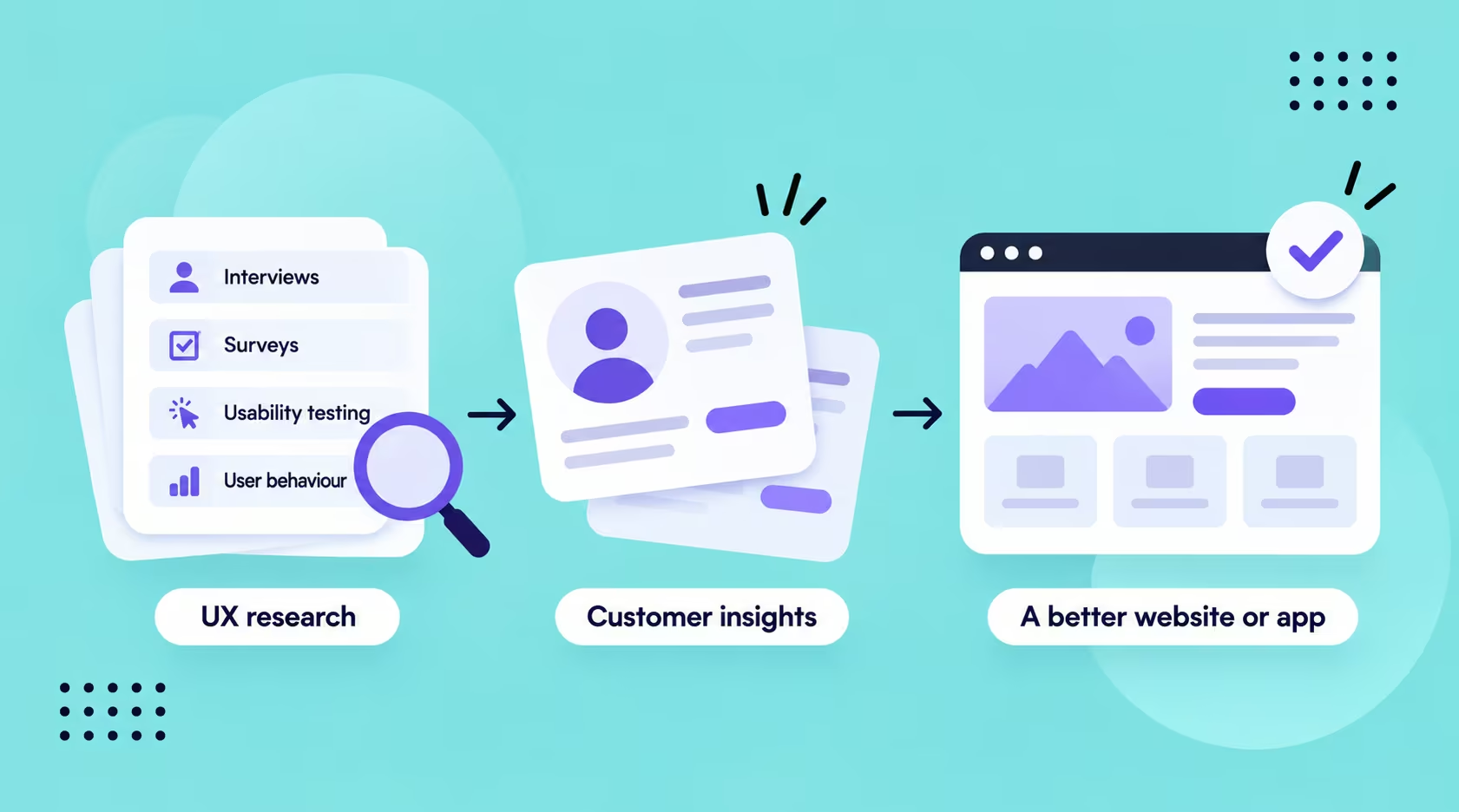
UX research is how you find out what customers look for and how they behave on your website or app. It then checks those findings against your business goals. The aim is simple: design decisions based on evidence, not guesswork.
When I explain it to clients, I call it a checklist. You list what your customers are looking for and what they are doing. Then you cross off what fits your business goals. Whatever does not fit tells you what to change. Most clients find that far easier to picture than a list of research methods.
It is not a niche idea. ISO 9241-210, the international standard for human-centred design, explicitly covers websites and applications. It treats understanding users and their context as part of designing any interactive system. The standard was last reviewed and confirmed in 2025, so this is current practice, not a trend.
Businesses are also leaning on research more. A 2026 industry survey by research platform Maze found that 66% of teams report higher demand for research. It also found 22% of organisations now treat research as essential to strategy, up from 8% in 2025.
You will also hear it called user research. The two terms mean the same thing, and this guide uses them interchangeably. Research is the first stage of the UX design process, and it shapes every stage after it.
What Does UX Research Tell You About Your Customers?
UX research tells you two different things: what customers say and what customers do. The two often disagree. Asking someone what they want gives you their opinion. Watching what they click shows you their behaviour. Good research uses both, because each one catches what the other misses.
Researchers call these attitudinal and behavioural data. The research field guide from User Interviews notes that attitudinal methods, such as surveys, rely on self-reported data. Behavioural methods record what people actually do. For a business owner, the practical lesson is simple. Customer opinion is only half the picture.
What Customers Say
Most of what customers say reaches you through people, not research reports. I start every project with a workshop with the client. It covers what they need, the problems they face and what they want to achieve. Where possible, sales and support staff join in. Customers go to them first, so they hear the questions and complaints first.
Customer success teams are a useful source for websites too. From time to time, they tell us customers came looking for information that was missing or incomplete on the site. We use that feedback directly to improve the website. For apps, interviews and surveys add more depth, usually with an incentive for the customers who take part.
What Customers Do
What customers do shows up in your data. For a website, I start with the user journey reports in Google Analytics 4 (GA4). They show where visitors click next, which content they look at and where they drop off. That tells you which pages are pulling their weight and which ones lose people.
Then I look at heatmaps in Microsoft Clarity, a free heatmap and session recording tool. Clarity shows which buttons are clicked most and how far people scroll before they reach the call to action. Together, the two tools show intent: what visitors came for, and how far they got.
What UX Research Is Not
UX research is often misunderstood, which is one reason clients treat it as secondary. Most of the confusion comes from four assumptions. Each one makes research sound slower, more expensive or less useful than it really is.
It Is Not Asking Customers What They Like
Asking customers whether they like a design produces opinions, not evidence. UX research is more concerned with what people are trying to do and where they get stuck. A customer may say they love a homepage and still never scroll past the first section. The behaviour is what the design has to respond to.
It Is Not a Large, Slow Study
Research for a website or app is not an academic project with hundreds of participants. For most of my projects, it takes about a week. The point is to spot the patterns that keep repeating, then design around them. Volume for its own sake adds time without changing the decisions.
It Is Not Only for Apps
Apps make it easier to recruit users for interviews, so research is often associated with them. Websites need it just as much. The difference is the source. On a website, GA4, Clarity and customer-facing staff do much of the work that interviews would do for an app.
It Is Not a One-Off
Research does not end when the design is signed off. One B2B software client's call-to-action buttons changed over time. A generic contact button gave way to a tested winner, then to new wording for a self-serve product. Each change came from watching how real visitors behaved after launch.
Exploratory vs Evaluative: The Two Types of UX Research
UX research splits into two types by timing. Exploratory research happens before design and decides what to build. Evaluative research happens once a design, prototype or live site exists, and checks whether it works. Most projects need both, in that order. The table shows how they differ.
Exploratory Research
Exploratory research is also called generative or discovery research. On BigFundr's investment app, I honestly did not know what good investing onboarding looked like. Five one-on-one sessions with people who already invested through other apps changed that. They walked me through those apps, and onboarding became the design priority.
Exploratory research is where the workshop, competitor review, interviews and surveys sit. Each suits a different budget and level of access to customers. Picking the right mix of exploratory research methods is what makes the research week productive.
Evaluative Research
Evaluative research checks a design against real behaviour. For a B2B software client, Clarity data showed a generic "Contact Us" button was not doing enough. We tested "Book a Demo" against "Consult for Free" in an A/B test. "Book a Demo" won, so that is the one we kept.
This is the stage for prototype sessions, usability testing and A/B tests. It runs on a working design rather than on ideas, so the findings turn straight into specific changes.
How Does UX Research Change What Gets Built?
UX research changes priorities, wording and structure, not just the look of a page. The changes are often small but very specific. Three of my own projects show what that looks like in practice, including one where the research never happened.
It Changes What You Prioritise
On BigFundr, research moved onboarding to the top of the list. Without the investor sessions, effort would have been spread evenly across every screen. Instead, the design concentrated on the moment a new investor signs up. That is where an investing app keeps or loses a customer.
It Changes the Words You Use
For the same B2B software client, research changed the words on the buttons. "Book a Demo" replaced "Contact Us" after the A/B test. When the client launched a self-serve product, we replaced the generic "Try for Free" with "Protect My Ads". "Try for Free" describes the act of signing up. "Protect My Ads" names the outcome the user actually wants, so a self-serve visitor knows exactly what clicking gets them.
It Shows You When a Project Is at Risk
On a large internal operations project, the research never happened. The finance, procurement and operations teams each used separate apps that did not connect. I only needed to understand how they communicated across those apps. No team would share its workflow, the designs could not meet the standard, and the project was cut short.
That is the business case in one story. Research costs far less than a design built on guesses. It is the clearest reason for treating UX design as an investment rather than a cost.
Where UX Research Fits in a Website or App Project
UX research sits at the start of a project, then returns once there is something to test. Before proper research begins, I compare the client's website against their competitors' sites. It gives everyone a gauge of where they stand. The research itself then runs alongside the stakeholder workshop.
For most websites and apps, a week of research is enough. The goal is patterns, not quantity. Once the same problems keep appearing across the workshop, data and feedback, you have enough to design. More interviews rarely change the direction after that point.
The main output is a proper sitemap, with recommendations for improving the current structure. Everything from the workshop is kept in Figma or FigJam. The client can review it there and agree on what happens next. Evaluative research follows later, on the prototype and after launch. That sequence is how we run our UX research services.
How Much UX Research Does a Small Budget Need?
On a small budget, the minimum is a stakeholder workshop plus a competitor review. Business owners usually know their competitors well. That makes this pairing quick, and it still gives the design a real starting point. I would rather cut scope than design without it.
Research is also one of the first things to ask about when choosing a UX designer in Singapore. A designer who skips it to save time is usually saving the wrong thing.
What Should You Prepare Before UX Research Starts?
A little preparation makes the research week far more productive. Most websites have little direct customer feedback, so your data and your staff matter even more. These are the things worth having ready before research begins:
- Access to Google Analytics 4, so user journeys and drop-off points can be reviewed
- Microsoft Clarity installed early, so there is heatmap and scroll data to read
- Notes from customer success, sales or support on what customers ask for or cannot find
- A list of the competitors your customers compare you with, and their websites
- Your business goals for the project, so every finding can be checked against them
If Clarity is not installed yet, add it as soon as you decide to redesign. It only records from the day it goes live. The earlier it starts, the more behaviour there is to study.
Frequently Asked Questions
Is UX research the same as user research?
Yes. UX research and user research describe the same work: learning what users need and how they behave. Some teams prefer "user research" because it keeps the focus on people rather than on the interface. In practice, the methods, timing and outputs are the same.
Is UX research being replaced by AI?
No, although AI is changing parts of it. Nielsen Norman Group found AI-generated "synthetic users" useful for desk research and early hypotheses, but not for final decisions. Real customers still behave in ways a model cannot predict. AI's wider impact on UX design follows the same pattern: faster production, with judgement still resting on people.
How long does UX research take?
For most website and app projects, about a week is enough. The aim is to find the patterns that repeat across the workshop, the data and customer feedback. Collecting as many responses as possible is not the goal. Larger products, or several very different user groups, may need longer.
Do I need UX research for a website redesign?
Yes, and a redesign is where it pays off fastest, because you already have data. GA4 shows where visitors drop off, and Clarity shows what they click. Without that, a redesign tends to repeat old problems in a new layout. Even a short workshop and competitor review beats starting blind.
Conclusion
This week, open GA4 and look at where visitors drop off on your three most important pages. If Clarity is installed, check how far people scroll before they reach your main button. Then add your sales or support team's most common customer questions to the list.
That list is the start of your UX research checklist. If the drop-offs point to deeper usability problems, a website usability audit is the logical next step.
{{build-better-experience="/directory"}}
Categories
Written By

Resources
Related Articles
Deep dive into our latest news and insights.