
Webflow for SEO: Why Marketers Love It in the AI Era
Webflow gives marketers clean code, fast performance, and full SEO control — purpose-built for AI-era search.
Table of contents
Free Website Audit
We'll personally review your website across 6 areas. UX, SEO, performance, mobile, conversion, and send you a detailed, actionable report within 48 hours. No cost. No catch.
Webflow has become the platform of choice for marketers who need speed, SEO control, and AI-ready content delivery — all without depending on developers. Built on clean semantic HTML, optimised for Core Web Vitals, and fully compatible with structured data, Webflow equips marketing teams to move fast and rank higher. As AI search engines increasingly favour structured, authoritative content, choosing the right platform is no longer a technical decision — it is a strategic one. Singapore businesses, in particular, stand to benefit from Webflow's performance-first architecture in an increasingly competitive digital landscape.
Search is changing — quietly, radically, and faster than most marketers can adapt. AI Overviews have rewritten how Google surfaces information. ChatGPT, Bing Copilot, and Perplexity are turning search into conversation. Your customers are no longer browsing — they are asking.
In this environment, your website's technical architecture is no longer a developer's concern alone. It is a marketer's competitive advantage. And that is precisely why so many marketing teams — globally and here in Singapore — are turning to Webflow.
This article unpacks why Webflow has earned its reputation as the marketer's platform for the AI era, and what it means for your organic growth strategy.
The New SEO Reality: AI Has Changed the Rules
Traditional SEO was built on a relatively simple premise: match keywords, earn links, rank higher. That model still holds weight — but it is no longer sufficient.
Today, search engines do not just index your content. They interpret it. Google's AI Overviews pull structured answers directly from crawled pages. ChatGPT Search builds narrative summaries from indexed websites. Bing Copilot synthesises context, not just links.
This shift demands something different from your website platform. It demands:
- Clean, semantic HTML that AI models can parse without confusion
- Structured data (schema markup) that communicates context explicitly
- Fast-loading pages that pass Core Web Vitals thresholds
- Content architecture that signals topical authority
- Full marketer control over SEO metadata — without developer dependency
Webflow was not designed for the old web. It was built — almost by accident — to thrive in this new one.
For a deeper look at how AI is reshaping search strategy, read: From Keywords to Conversations: How AI Is Rewriting the Rules of Search.
Why Marketers Choose Webflow for SEO
At its core, Webflow gives marketers something no other mainstream CMS platform has managed to deliver cleanly: full website control without full technical dependency. That matters enormously in a world where speed of execution is a ranking signal in its own right.
Let's break down the specific reasons why marketers are choosing Webflow over alternatives like WordPress, Squarespace, or Wix — particularly when SEO is a priority.
1. Clean Semantic Code — AI's Native Language
AI search models do not read your content the way a human does. They parse HTML structure. They look for hierarchy, relationships, and clarity. When your code is bloated with unnecessary scripts, redundant divs, or plugin-generated markup, AI models struggle to extract meaning.
Webflow generates clean, semantic HTML5 by design. Headings follow proper hierarchy. Elements are labelled correctly. There is no plugin-induced bloat, no legacy script conflicts, and no theme overrides quietly breaking your DOM structure.
The result: AI crawlers can read your Webflow site more clearly than 90% of WordPress sites with comparable content. That clarity translates directly into citation eligibility in AI Overviews and Answer Engine results.
To understand how this connects to UX and conversion performance, read: SEO and UX: How to Build a Website That Ranks and Converts.
2. Core Web Vitals Performance — Built In, Not Bolted On
Google's Core Web Vitals — Largest Contentful Paint (LCP), Cumulative Layout Shift (CLS), and Interaction to Next Paint (INP) — are confirmed ranking signals. Most CMS platforms treat these as problems to be solved after launch, via optimisation plugins and caching layers that add their own complexity.
Webflow treats performance as a default. Its hosting infrastructure runs on AWS and Fastly's global CDN. Images are compressed and lazy-loaded out of the box. CSS and JavaScript are automatically minified. There is no plugin stack to maintain, no theme conflicting with your caching rules.
ALF Design Group clients who migrate from WordPress to Webflow typically see measurable improvements in load time within the first month — with corresponding lifts in bounce rate and organic sessions.
Read more: How Webflow SEO Helps Singapore Businesses Rank Higher on Google.
3. Full SEO Control Without Developer Queues
One of the most common frustrations marketing teams report is the "developer queue problem" — needing to raise a ticket, wait days, and lose momentum every time a meta title needs updating or a redirect must be added.
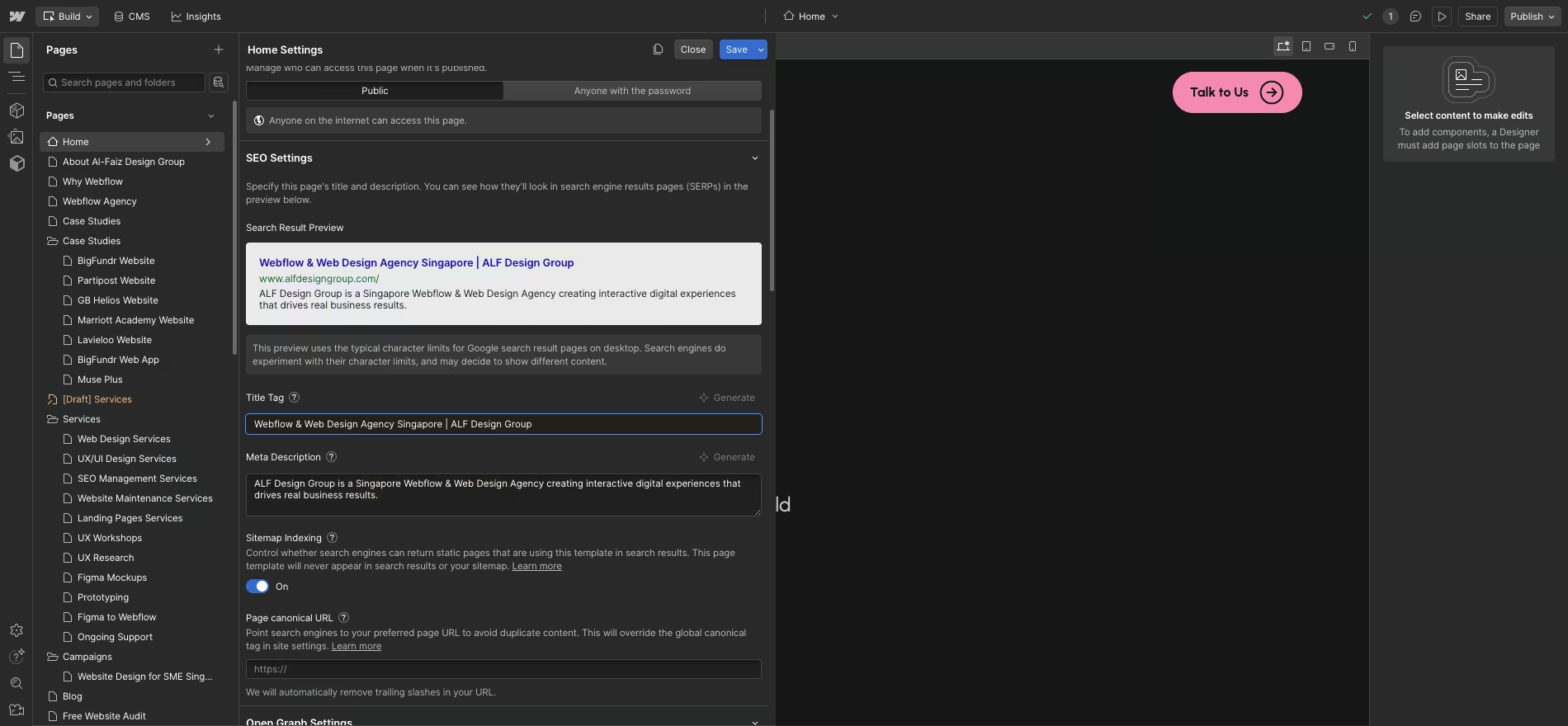
Webflow eliminates this. Every SEO field is accessible directly through the CMS or Designer interface:
- Meta titles and descriptions — editable per page and per CMS collection
- Canonical tags — controllable without code
- 301 redirects — manageable through a clean dashboard interface
- Alt text — editable on every image asset
- Indexing controls — per-page noindex settings available natively
- Open Graph and social sharing tags — built into every page template
Marketers can update, test, and publish SEO changes independently. That agility matters when content needs to respond to trending queries or algorithm updates within hours, not weeks.
4. Schema Markup — The Structured Data Advantage
AI search engines rely on structured data to understand context. A page about "web design services" means something very different from a page about "web design tips" — and schema markup is how you communicate that difference explicitly to search engines and AI models alike.
Webflow allows marketers and developers to inject custom JSON-LD schema directly into any page or CMS template. Common schema types used in SEO-mature Webflow sites include:
- FAQPage — for FAQ sections targeting featured snippets and AI Overviews
- Article — for blog posts and editorial content
- Service — for service landing pages
- LocalBusiness — critical for location-based discovery
- HowTo — for tutorial-style content
- BreadcrumbList — for navigational context
For a full breakdown of how structured data improves visibility: How Schema Markup Improves CTR and Search Visibility
5. The CMS Marketers Actually Enjoy Using
Webflow's CMS was designed with content velocity in mind. Collections allow you to build scalable content structures — blogs, case studies, landing pages, FAQs — with SEO fields built in at the template level rather than added as an afterthought.
Publishing a new article takes minutes. Updating a service page takes seconds. A/B testing a landing page headline no longer requires a developer to clone the page and set up a redirect. Marketers can execute, iterate, and optimise without friction.
For teams managing multiple campaigns simultaneously, this speed is not just convenient — it is a genuine competitive advantage.
Learn more: What Is Webflow CMS? Everything You Need to Know.
Why Webflow Is Especially Relevant for Singapore Businesses
Singapore's digital landscape is distinctly competitive. With high internet penetration, mobile-first consumer behaviour, and a concentrated B2B market where a handful of decision-makers research vendors before every procurement decision, your website's ability to rank, load quickly, and answer questions accurately is disproportionately valuable.
Several factors make Webflow particularly well-suited to the Singapore market:
Search Behaviour Is Shifting Toward AI in Singapore
Singapore consumers and professionals are among the earliest adopters of AI-powered search tools in Southeast Asia. AI Overviews are already appearing prominently in local search results. If your website is not structured for AI interpretation — clean code, schema, fast load times — you are effectively invisible to a growing portion of your target audience.
Read: The Future of SEO: What Businesses in Singapore Need to Know.
SMEs Need Marketing Independence
Many Singapore SMEs operate with lean marketing teams — often a team of one or two managing all digital channels. The ability to update SEO metadata, publish blog content, and launch landing pages without raising a developer ticket is not a luxury. It is a business continuity requirement.
Webflow's no-code content management gives Singapore marketing teams that independence without sacrificing the technical quality that SEO demands.
Webflow's Global CDN Means Fast Load Times in Asia
Website speed in Southeast Asia can vary significantly depending on hosting infrastructure. Webflow's CDN — powered by Fastly and AWS — ensures fast load times across Singapore, Malaysia, and the broader APAC region. For businesses targeting both local and regional audiences, this geographic performance consistency is a meaningful advantage.
Explore: Discover Why SEO and Marketing Agencies Recommend Webflow for Website Redesign.
Webflow vs WordPress: The SEO Comparison Marketers Need
WordPress remains the most widely used CMS in the world — but its dominance was built in a different era. Here is an honest comparison for marketers evaluating both platforms purely on SEO capability:
For a comprehensive head-to-head, read: Webflow vs WordPress (2026): Which Platform Is Right for Your Business?
AEO: How Webflow Helps You Win in Answer Engine Optimisation
AEO (Answer Engine Optimisation) is the emerging discipline of optimising content not just for search rankings but for direct citation in AI-generated answers. It is where SEO and content strategy converge — and Webflow is exceptionally well-positioned to support it.
The key requirements for AEO-ready content are:
- Clearly structured content with proper heading hierarchy
- FAQ sections with concise, direct answers
- FAQPage schema injected via custom code
- Short, authoritative sentences that AI can extract as standalone answers
- Fast load times so crawlers can access your content reliably
- Internal linking that signals topical depth
Webflow supports all of these natively. Heading structure is enforced by the designer interface. Custom code embeds allow FAQPage schema to be injected directly into CMS collection templates. And performance — as discussed — is built into the platform's DNA.
For a tactical guide, read: How To Optimise Your Website for AI Search and AI Overviews: How to Appear in AI-Generated Search Results.
What Marketers Are Actually Migrating Away From
To understand Webflow's appeal, it helps to understand what marketers are escaping. The frustrations are consistent across industries:
- Plugin conflicts that break SEO configurations overnight
- Theme updates that override custom schema or redirect settings
- Developer queues blocking routine meta tag updates for days or weeks
- Slow dashboards that make A/B testing impractical
- Hosting environments that cannot support CDN delivery to APAC audiences
- CMS interfaces designed for developers, not content teams
Webflow does not just solve these problems — it removes the category of problem entirely. There are no plugins to conflict. No theme to break. No dev queue for SEO tasks. The result is a marketing team that executes faster, ranks more consistently, and iterates without friction.
See how this plays out in practice: Is Webflow Worth It? A Honest Guide for Businesses in 2026.
How ALF Design Group Uses Webflow to Drive SEO Results
As a Webflow-specialist agency based in Singapore, ALF Design Group builds every client website with SEO architecture as a first principle — not an afterthought.
Our approach includes:
- Semantic HTML structure validated before every launch
- Core Web Vitals benchmarking during QA
- FAQPage and Service schema embedded in CMS templates
- Redirect mapping and canonical configuration pre-migration
- Internal linking architecture designed to support content clusters
- Training for marketing teams to manage SEO fields independently
We have seen clients move from page three to page one rankings within three months of migrating to a properly structured Webflow build — not because we invented new SEO techniques, but because the platform allows those techniques to be executed cleanly and consistently.
Explore our work: Visually Stunning Websites Built in Webflow. Or learn more about 5 Key Things to Do Before Building in Webflow.
If you are evaluating Webflow for your next build, start here: /why-webflow. Or speak to us about SEO services built around your Webflow site.
Frequently Asked Questions
Is Webflow actually good for SEO?
Yes — Webflow is one of the strongest CMS platforms for SEO in 2026. It generates clean semantic HTML, delivers fast load times through a global CDN, supports full schema markup injection, and gives marketers complete control over every SEO field without requiring developer involvement. It performs well for both traditional search rankings and AI-era Answer Engine Optimisation (AEO).
How does Webflow compare to WordPress for SEO?
Webflow consistently outperforms WordPress on technical SEO fundamentals. While WordPress requires plugins like Yoast or RankMath to match Webflow's native SEO capabilities, those same plugins introduce performance overhead and dependency on third-party developers. Webflow delivers equivalent — often superior — SEO functionality with none of the plugin risk.
Can marketers manage Webflow SEO without a developer?
Largely, yes. Meta titles, descriptions, canonical tags, redirects, alt text, indexing settings, and Open Graph tags are all manageable directly through Webflow's interface. Custom schema injection requires pasting JSON-LD into a code embed field — a task most content-savvy marketers can handle with a short briefing.
Does Webflow support structured data and schema markup?
Yes. Webflow allows custom JSON-LD schema to be injected via page or CMS collection code embeds. Common implementations include FAQPage, Article, Service, LocalBusiness, and HowTo schemas. ALF Design Group typically implements schema at the collection template level so it populates automatically across all CMS items.
Is Webflow suitable for Singapore businesses targeting local SEO?
Absolutely. Webflow's CDN infrastructure ensures fast load times across Singapore and the APAC region. Combined with LocalBusiness schema, geo-targeted landing pages, and Singapore-specific content, Webflow is an excellent foundation for local SEO campaigns targeting Singapore consumers and B2B decision-makers.
What is AEO and how does Webflow support it?
AEO (Answer Engine Optimisation) is the practice of structuring your content to be cited directly in AI-generated answers — in tools like Google AI Overviews, ChatGPT Search, and Perplexity. Webflow supports AEO through clean heading structure, fast performance (enabling reliable AI crawling), native support for FAQPage schema, and a CMS that makes it easy to publish well-structured, authoritative content at scale.
How long does it take to see SEO improvements after migrating to Webflow?
This depends heavily on the quality of the migration — whether redirects are correctly mapped, content structure is maintained, and schema is properly implemented. When migrations are handled correctly, many businesses see ranking stability within the first four weeks and measurable improvement within three months. ALF Design Group includes migration SEO as a standard component of every Webflow build.
Conclusion: Webflow Is Not Just a Platform — It Is an SEO Strategy
The era of separating "technical SEO" from "platform choice" is over. In a landscape where AI models parse your HTML structure, where Core Web Vitals are confirmed ranking signals, and where the speed of your content team's execution determines your organic growth trajectory — your CMS is your strategy.
Webflow gives marketers the clean code, performance infrastructure, schema capability, and editorial independence they need to compete — not just in Google's traditional rankings, but in the AI-generated answers that are increasingly replacing them.
For Singapore businesses looking to build a website that ranks, converts, and scales — Webflow is the answer. And the right agency partner makes all the difference.
Explore our Webflow services, review our SEO services, or get in touch for a conversation about your next build.
{{build-better-experience="/directory"}}
Written By
.webp)
Resources
Related Articles
Deep dive into our latest news and insights.