How Outdated Content Is Quietly Damaging Your Brand in AI Search
Outdated content on your site and third-party listings can damage your brand every time AI cites it. Here is what to do.
Table of contents
Free Website Audit
We'll personally review your website across 6 areas. UX, SEO, performance, mobile, conversion, and send you a detailed, actionable report within 48 hours. No cost. No catch.
Your brand is the most important thing your business owns. And right now, AI search tools — ChatGPT, Perplexity, Google AI Overviews — may be citing outdated, inaccurate information about your business every single day, to potential customers you will never know you lost. This is not a problem caused by content that is old. It is a problem caused by content that is no longer true. The distinction matters, and so does the fix.
Let me be direct about something most businesses have not considered yet.
When a potential customer asks an AI tool a question about your industry, your pricing, or your services, the AI does not call your office. It does not check your latest brochure. It retrieves answers from content it has already indexed — content that may be months or years out of date — and it presents that information confidently, often with your website cited as the source.
If that content is wrong, your brand carries the blame.
The AI is not at fault. It is only citing what it was fed. But the customer sitting across from a wrong answer does not see it that way. They see your brand name next to incorrect information, and they make decisions based on it.
This is the quiet brand damage that most Singapore businesses are not yet aware of — and the window to get ahead of it is now.
What 'Outdated Content' Actually Means
This is the first thing to get right, because most people misunderstand it.
Outdated content does not simply mean old content. A blog post from 2019 that still accurately answers a user's question is not a problem — it may in fact be one of your most valuable assets. I have seen content from several years ago being regularly cited by AI systems because it answers a specific question clearly and completely. Age alone is not the issue.
The real problem is content that is no longer accurate. Content that describes a pricing structure you changed. Content that explains a process you no longer follow. Content that references a tool, a regulation, or a platform feature that has since been updated or discontinued.
A concrete example: in May 2026, Google officially deprecated FAQ rich results — adding a notice to their structured data documentation confirming that FAQ schema no longer produces rich results in search. But at the time of writing, many websites still carry content stating that FAQ schema is one of the most effective tactics for improving search visibility. That content is now factually wrong, and any AI that cites it is giving a user incorrect advice attributed to your brand.
Another example I see frequently: pricing. Software pricing changes. Platform pricing changes. Agency pricing changes. I have personally asked an AI tool to generate a comparison table between Webflow and WordPress pricing, and received a table showing old price points — sourced from articles that had not been updated since the platforms restructured their plans. The articles still existed. The AI still found them. The prices were wrong.
The key distinction: Content that is old but accurate = an asset. Content that is factually wrong = a brand liability. The question to ask about every piece of content is not 'when was this written?' but 'is this still true?'
Why Your Brand Gets Blamed, Not the AI
When an AI tool gives a user incorrect information, the instinct is to blame the AI. And on a surface level, that makes sense — it generated the answer.
But the moment a user traces that answer back to its source — and many do — the accountability shifts. The AI becomes the messenger. Your website, your content, your brand name become the origin of the wrong information.
In Singapore's professional services market, where buyers are often comparing multiple providers and doing thorough research before making contact, this matters more than you might expect. A prospect who finds incorrect pricing information attributed to your website may not enquire to clarify. They may simply move on, with a mental note that your brand is either uninformed or careless.
You will never know that conversation happened. That is what makes this type of brand damage so difficult to measure and so easy to ignore.
The harder truth: You cannot control what AI systems cite. You can only control what is on your website — and on the third-party sites that reference your business — for them to find.
The Third-Party Problem: The Damage You Cannot See
If the only outdated content about your business lived on your own website, the fix would be straightforward. Update your pages, correct the facts, move on.
The harder problem is the content that lives elsewhere.
Think about every directory listing, comparison site, review platform, industry publication, or press mention that references your business. Think about every article a blogger wrote about your pricing two years ago, every roundup that included your service descriptions, every third-party review that quoted details from your old website.
Those sites have their own content. They do not automatically update when you update yours. And AI systems do not weight your own website more highly than a well-established third-party source — in some cases, they weight it less, because high-authority external sites carry more trust signals.
This means an article on a high-authority comparison site describing your old pricing structure may be the version an AI cites, not your current pricing page. Your pricing page may have been updated months ago. The third-party article is still serving the old information.
From a practical standpoint, this is the most difficult dimension of the outdated content problem — and also the most underestimated. When businesses audit their own content, they audit their own website. Very few audit what is being said about them elsewhere on the internet, and almost none track which of those external sources are being picked up by AI systems.
What You Can Actually Do About It
There is no single technical fix for this problem. But there is a practical approach that addresses the most important dimensions systematically.
1. Start With Cannibalisation, Not Keyword Rankings
The most common mistake in content auditing is to start by looking at which articles are performing well or poorly in search rankings and trying to improve them individually. That is backwards.
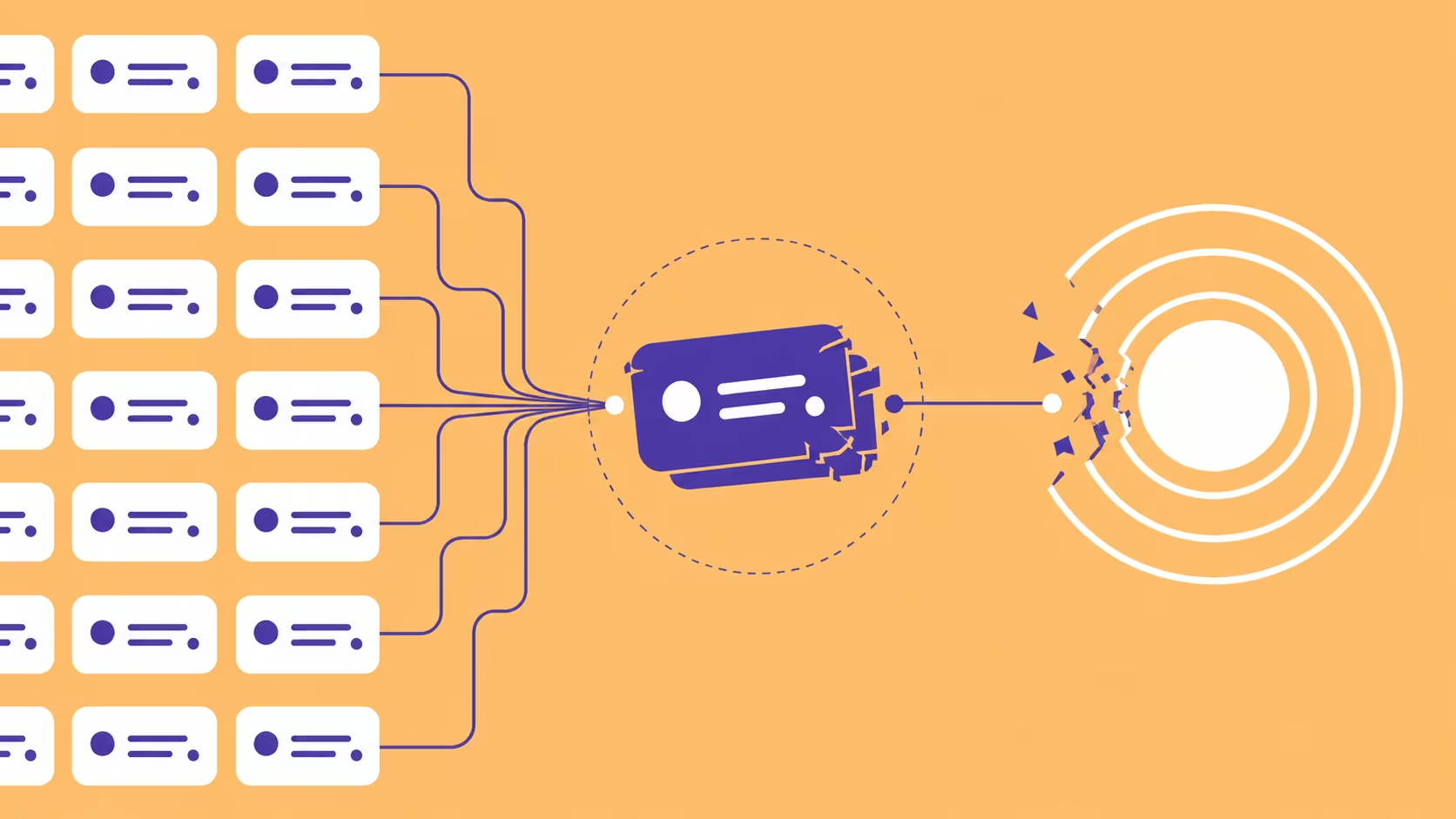
The right starting point is cannibalisation — identifying where two or more pieces of content on your own website are targeting the same question or keyword. When this happens, search engines and AI systems face an ambiguity problem: they cannot confidently determine which page is the authoritative answer, so they may cite neither clearly, or alternate unpredictably between them.
Cannibalisation also compounds the outdated content problem. If you have three articles covering similar ground, the chances that at least one of them contains outdated information increases significantly — and with multiple competing pages, it is harder to maintain accuracy across all of them.
The fix is to consolidate: identify which page is the strongest, update and improve it, and either redirect the weaker pages to it or clearly differentiate their angles so they no longer compete. This is one of the first things we assess in an SEO and content audit for new clients.
2. Audit by Cluster, Not by Article
Once cannibalisation is addressed, the content update process should be organised by topic cluster — not by individual article performance.
A topic cluster is a group of related articles covering different angles of the same subject. One article might be the broad overview. Others might cover specific aspects, use cases, comparisons, or frequently asked questions within that topic. Together, they signal topical authority to both search engines and AI systems.
The cluster approach matters for two reasons. First, when you update content in isolation — improving one article because it is declining in rankings — you often create internal inconsistencies. The updated article may now contradict something in a related article, or miss an opportunity to reinforce a point made elsewhere in the cluster.
Second, AI systems increasingly evaluate topical depth, not just individual page quality. A cluster of coherent, consistent, mutually-reinforcing content signals genuine expertise. A collection of disconnected articles with varying levels of accuracy signals the opposite.
In practice, we organise content updates at ALF by reviewing Google Search Console data by cluster — identifying which topic areas are generating impressions without converting to clicks, which clusters have the most cannibalisation, and which clusters contain the highest density of potentially outdated information. We did exactly this with a client in the ad fraud and brand safety space, rebuilding their keyword clusters and updating content systematically by topic rather than article by article. The result was a more coherent content footprint and a more authoritative signal to both Google and AI systems about what the business actually knows. This approach is detailed further in our keyword research guide.
3. Prioritise Content That Contains Time-Sensitive Facts
Not all content has equal risk of becoming outdated. The highest-risk content categories are:
- Pricing and packaging: any content that states specific prices, plan structures, or what is included in a service. This changes frequently and is one of the most commonly cited types of content in AI search answers.
- Platform features and integrations: content that describes how a specific tool or platform works. Software updates constantly. Features are added, removed, and restructured.
- Regulatory and compliance information: particularly relevant for Singapore businesses in finance, legal, healthcare, and data privacy. MAS guidelines, PDPA requirements, and industry regulations change.
- Statistical claims: any article that cites specific statistics, market data, or research findings. These become outdated as new data is published.
- Best practice recommendations: tactics that were effective in a previous era of SEO, design, or marketing may now be counterproductive. FAQ schema is a clean example — widely recommended until May 2026, now deprecated.
These categories of content deserve a structured review at least once per year, and ideally whenever a significant industry change occurs that might affect their accuracy.
4. For Third-Party Content — Reach Out Directly
This is the unglamorous part of the fix, and I will be honest: there is no elegant technical solution here.
When inaccurate information about your business exists on a third-party website — an old pricing article on a comparison site, a directory listing with outdated service descriptions, a blog post that referenced your old process — the only reliable fix is to contact the site owner directly and ask them to update or remove it.
This is time-consuming. It does not always work. Some sites will update promptly; others will not respond. But it is the only direct lever you have over content that lives outside your own domain.
Before you reach out, make sure your own content is correct first. If a third-party site is citing your old pricing page, update your pricing page before contacting them — otherwise you are asking them to reference content that you have not yet fixed yourself.
A prioritised outreach list typically starts with: high-authority sites (those that are most likely to be cited by AI systems), sites that appear prominently when you search your own business name, and any comparison or review platforms where your business is actively listed.
Practical starting point: Search your business name in ChatGPT, Perplexity, and Google AI Overviews. Note every fact that is cited about your business. Cross-reference each fact against your current website. Any discrepancy is either a problem on your site or a problem on a third-party site — and now you know where to look.
A Note on What This Is Not
This article is not about publishing more content to bury the old. That approach — producing volume in the hope that newer articles will displace older inaccurate ones — often makes the problem worse. More articles targeting overlapping topics increases cannibalisation. More output without a clear accuracy strategy adds more surface area for outdated information to accumulate.
It is also not about chasing every AI system's citation logic. AI retrieval systems evolve constantly, and optimising specifically for how one platform cites content today may be irrelevant in twelve months.
The more durable approach is simpler: keep your content accurate, keep it organised, and keep it consistent. An AI system that cites a well-maintained, internally coherent body of content is far more likely to represent your brand correctly than one that cites a collection of articles in varying states of accuracy.
For a practical framework on measuring how your content is performing in AI search — including how to track citation frequency and answer ownership — our guide on AEO metrics covers the measurement side in detail.
The Bigger Picture: Your Brand Is What Gets Cited
Every time an AI tool answers a question about your industry, your services, or your business, it is making a micro-decision about whose content to trust. That decision is based on what it finds — not what you wish it would find.
Your brand is not just your logo, your tagline, or your service offering. In the age of AI search, your brand is the sum total of everything that can be found and cited about you — on your own website and everywhere else on the internet that references your business.
If that information is accurate, consistent, and well-organised, AI search becomes a brand asset. Every citation is an unpaid endorsement.
If that information is patchy, contradictory, or wrong, AI search becomes a brand liability. And the damage happens quietly, in conversations you are never part of, before a customer ever makes contact.
The businesses that understand this early are the ones that get ahead of it. The ones that wait until the damage is visible are the ones who spend twice as much fixing it.
To see how AI systems choose what to cite, start with our guide to what AEO is.
Frequently Asked Questions
How do I know if AI tools are citing outdated content about my business?
The fastest way is to test it directly. Open ChatGPT, Perplexity, and Google AI Overviews and ask questions about your business: what you charge, what your services include, how your process works, what tools or platforms you use. Note every specific fact that comes back and cross-reference it against your current website. Any discrepancy — a price that has changed, a feature that no longer exists, a process that has been updated — indicates either a problem on your own site or a third-party source that is carrying old information. This manual audit takes less than an hour and is the clearest way to see what AI systems are actually saying about your brand.
Does old content always get cited by AI?
Not necessarily. Age alone does not determine whether content gets cited. AI systems evaluate relevance, authority, and how clearly a piece of content answers a specific question. A well-written article from several years ago that directly answers a user's query may be cited consistently. A recent article that is vague or poorly structured may never be cited at all. The problem is not old content — it is inaccurate content. An article that used to be correct but is now factually wrong is the genuine risk, regardless of when it was published.
What types of content are most likely to cause brand damage when outdated?
Pricing and packaging information is the highest risk — it is frequently cited in AI answers and changes often. Platform or tool-specific content (features, integrations, capabilities) is close behind because software updates constantly. Regulatory or compliance content carries high risk for Singapore businesses in regulated industries. Statistical claims and market data become outdated as new research is published. Best practice recommendations are particularly problematic when the underlying platform or algorithm has changed — FAQ schema advice is a current example where pre-May 2026 recommendations are now incorrect.
Can I control what AI tools say about my business?
Not directly. AI systems make independent decisions about which content to retrieve and cite. What you can control is the quality and accuracy of the content available for them to find — on your own website and, where possible, on third-party sites that reference your business. The most effective approach is to ensure your own content is accurate, well-organised by topic cluster, and free from internal contradictions or cannibalisation. For third-party content, direct outreach to site owners is the only available lever.
How often should I audit my content for accuracy?
At a minimum, review your highest-risk content categories — pricing, platform specifics, regulatory information, and best practice recommendations — once per year. In practice, the right trigger is any significant change in your industry, your services, or the platforms you reference. When a major SEO, design, or technology update occurs (like Google's FAQ schema deprecation in May 2026), any content you have on that topic should be reviewed immediately. For a structured approach to content auditing alongside broader technical SEO health, our AI SEO audit checklist covers the full framework.
What is the difference between a content audit and an SEO audit?
An SEO audit typically covers technical performance — page speed, crawlability, indexation, backlink health, and keyword rankings. A content audit focuses on what the content actually says — whether it is accurate, whether it is organised coherently by topic, whether any pieces are cannibalising each other, and whether the overall body of content reflects your current business accurately. Both are necessary, and they are most effective when done together. If you are unsure where to start, a free website audit from ALF Design Group covers both dimensions and gives you a clear picture of where the most urgent issues are.
Conclusion: Get Ahead of It Now
Your brand is the most important thing your business owns. If AI tools are citing something wrong about your brand — your pricing, your process, your capabilities, your position in the market — you need to find it and fix it. Not because AI search is the future, but because it is the present, and your potential customers are using it today.
The businesses that treat content accuracy as an ongoing discipline — not a one-time project — are the ones that benefit most from AI search. Every accurate, well-organised citation is an endorsement that costs nothing and reaches an audience at the exact moment they are looking for what you offer.
The ones that wait until the damage is visible will spend more time and money correcting it than they would have spent preventing it.
If you would like to understand what AI search is currently saying about your business and where the accuracy gaps are, start with a free website audit. Or if you would prefer to talk through your content strategy directly, get in touch — we are happy to walk through it with you.
{{build-better-experience="/directory"}}
Written By

Resources
Related Articles
Deep dive into our latest news and insights.

.webp)