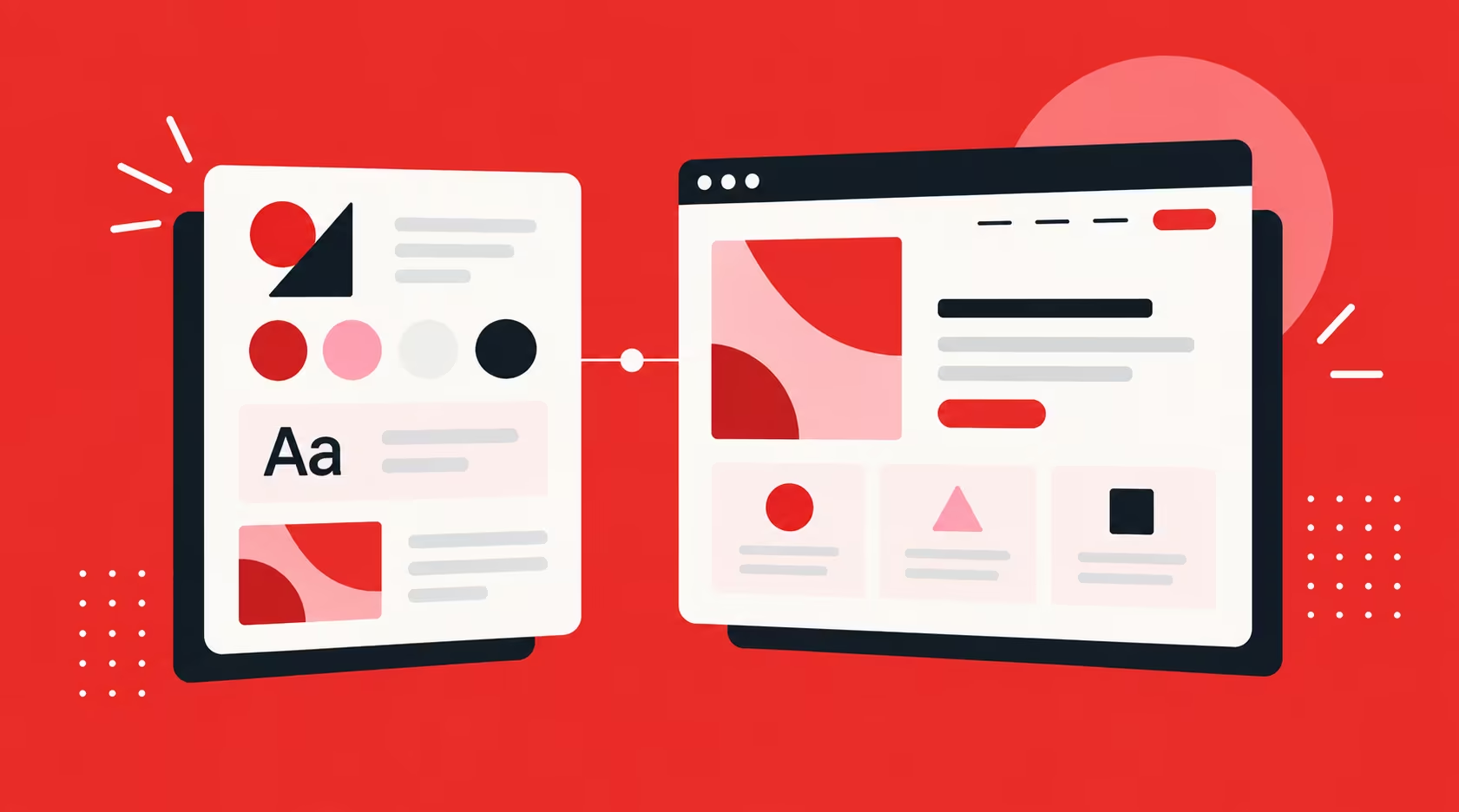
Branding vs Web Design: What's the Difference and Why Both Matter
Why branding and web design are different disciplines, and why sequencing them right saves Singapore businesses money.
Table of contents
Free Website Audit
We'll personally review your website across 6 areas. UX, SEO, performance, mobile, conversion, and send you a detailed, actionable report within 48 hours. No cost. No catch.
Branding and web design solve different problems. Mixing up their order is a costly mistake for a Singapore business. Branding defines who a business is: its positioning, voice, and visual identity. Web design turns that identity into a working website: structure, interaction, and performance. Get brand strategy sorted first, and a designer has real material to work with. Skip it, and most businesses pay twice. First for a site that looks fine but says nothing. Then again later, when the brand catches up and the site needs rebuilding around it.
Treating Them as the Same Thing Gets Expensive
It's one of the most common points of confusion for a growing business. Branding and web design get treated as synonyms, or lumped into one vague category: 'the visual stuff'. They aren't the same thing, and treating them as such tends to be expensive. Build a website before your brand is defined, and the bill usually arrives eighteen months later, as an unplanned rebuild.
The distinction matters practically, not just theoretically. Brief a web design agency before your brand identity exists, and the designer has only aesthetics to work with. Invest in a strong brand strategy, then leave it sitting in a PDF. If your website contradicts that strategy at every turn, it's wasted. Both disciplines need each other. But they answer different questions, and they need to happen in order.
What Does Branding Actually Cover?
Branding is the strategic and creative work of defining what a business stands for. It's also about how a business should be perceived. It isn't a logo, and it isn't a colour palette. Those are outputs of a branding process, tangible artefacts that represent something deeper.
At its core, branding answers one question: what do we want people to think and feel about this business? That touches on positioning, personality, and voice. It also touches on the emotional territory a brand wants to occupy in its audience's mind.
The components of a brand
- Brand positioning: where the business sits relative to competitors, and what it stands for that others don't.
- Brand personality: the human traits associated with it, authoritative or approachable, bold or considered.
- Brand voice: the tone and language used everywhere, from website copy to client emails.
- Visual identity: the logo, colour palette, typography, and imagery that make the brand recognisable.
- Brand values: the principles that guide how the business behaves and treats its customers.
For a formal definition of what a brand covers beyond visuals, see the American Marketing Association's overview of branding.
Only one item on that list has a direct, visible expression on a website: visual identity. Everything else is strategic and conceptual. Branding lives in documents, and in how staff speak to clients. It shows up in which work a business takes on. It's built over time through consistent behaviour, not just consistent visuals.
How Does Web Design Turn Brand Strategy Into Something Real?
Web design is the discipline of creating the visual, structural, and interactive experience of a website. Where branding is strategic, web design is executional. It takes the decisions made during branding and gives them a working form on screen.
Good web design works across several dimensions at once. Visually, typography, colour, layout, and imagery need to read as one coherent aesthetic. Structurally, the information architecture and navigation need to make things easy to find. Functionally, load speed and mobile responsiveness affect whether a visitor completes the action the site was built to encourage.
The components of web design
- Visual design: applying brand colours, typography, and imagery consistently across every page.
- Information architecture: organising content so visitors navigate without friction.
- User experience (UX): the journey from entry point to conversion, made to feel natural.
- Interaction design: how elements respond to actions, hover states, feedback, transitions.
- Responsive design: the site working as well on mobile as it does on desktop.
- Performance: load speed, Core Web Vitals, and the technical factors search engines weigh.
Web design also moves in shorter cycles than branding. A brand strategy can stay fundamentally unchanged for a decade. A website more often needs meaningful updates. That's rarely because the brand changed. It's usually because design standards and user expectations moved on. For a deeper look at what makes web design effective, see our guide on web design best practices.
Branding and Web Design Side by Side
Laid out next to each other, the two disciplines answer different questions. They also run on different timelines, and get judged by different measures of success.
Which Comes First: Brand Strategy or Web Design?
The sequencing question is where many Singapore businesses go wrong. The temptation is to launch a website quickly, before brand strategy has been properly worked out. That almost always produces a site that reads as a pile of design decisions. It rarely adds up to a coherent point of view.
The correct order is brand strategy first, web design second. Not because one matters more, but because web design needs source material. A designer working without a defined brand has no foundation to build from. So they make aesthetic choices by default, and those choices reflect the designer's taste rather than the business's identity.
The cost of getting this wrong is well documented. A widely cited industry survey of over a thousand marketing professionals found something specific. A typical rebrand requires updating an average of 215 separate brand assets. It also takes around seven months from initial talks to rollout. That's the real, measurable cost of fixing the brand after a website already exists, rather than before one is built.
This is the principle behind how we work at ALF Design Group. Every web design project begins with discovery. That establishes clarity on positioning and messaging before any visual design starts. The website then becomes an expression of a strategy that already exists, rather than a stand-in for one.
When Brand and Web Design Have to Move in Parallel
There's a genuine exception worth naming. I once ran a project for a fintech client. Their first website was built around visual trends, 3D animated figures and all, rather than any defined brand. By their fourth version, they were going through an active rebranding exercise. That happened midway through the project, so I had to work to their timeline rather than the ideal one. Parallel branding and web design can work, though. I run a UX-first process, so laying out infrastructure, content architecture, and strategy comes before any visual design begins. A brand that's still catching up doesn't have to block that groundwork.
In practice, the trade-off looks like this. Start on a website's style guide using what a business already has, since its logo usually stays consistent. Get a copywriter to align new messaging with existing brand voice, rather than waiting for a full brand overhaul. Most Singapore businesses don't want a major brand revamp anyway. This middle path works more often than the textbook sequence suggests.
Where Do Branding and Web Design Overlap?
The clearest overlap is the visual identity system. When a brand sets its colour palette, typography, and imagery style, those decisions become direct inputs to web design. A competent designer translates that identity into a digital system. Heading styles, button colours, card layouts, and photography direction all derive from the brand guidelines.
The overlap runs deeper than visuals, though. Brand voice shapes how copy reads across the site. Brand positioning shapes which messages get priority on the homepage. Brand values shape UX decisions too. A brand built on transparency might design a pricing page that's unusually explicit about costs. Done well, the website is brand strategy made tangible.
The reverse also holds. A website can undermine a brand if the two aren't aligned. A premium brand with a slow, visually inconsistent site signals something different from its claimed positioning. The role of web design in building your brand goes further into exactly this. It covers how execution reinforces or undermines what a brand claims to stand for, once sequencing itself isn't in question.
Why Singapore Businesses Keep Getting This Wrong
'We just need a logo and a website'
A logo isn't a brand. It's one output of a branding process, a symbol that only comes to represent a business's values over time. That takes consistent use, not a single design sprint. Businesses that skip brand development often go straight to logo design. A year later, the logo tends to not 'feel right'. It was never grounded in anything to begin with.
'Our web designer will handle the branding'
Web designers and brand strategists are different disciplines. Some people are skilled in both, but the skills aren't the same. Clients tend to over-rely on web designers to understand a brand that was never properly written down. My usual answer is that I can handle layout and structure. But every further design change down the line, without clear brand groundwork, tends to cost more, not less.
With that fintech client, this played out directly. Their first build followed design trends rather than any real brand direction. The actual branding work only started at their third version. Web design resumed on top of it after that. Everything got noticeably faster once fonts, messaging, and imagery followed one brand guideline. Nothing had to be reinvented page by page.
'Once we launch the site, we're done'
Both disciplines need ongoing attention. A brand needs active management: consistent expression across every touchpoint, reviewed as the business evolves. A website needs maintenance, measurement, and improvement based on how people actually use it. For what ongoing website maintenance actually involves, our guide covers why the work doesn't end at launch.
'Our competitors don't focus on branding, so we don't need to either'
That's precisely the opportunity. In Singapore's competitive market, most SMEs have sites that are functionally fine but brand-incoherent. They're assembled from templates and generic messaging that could belong to any business in any industry. A business that invests properly in both stands out strategically, not just aesthetically.
The Practical Path for Singapore Businesses
Singapore's market has particular pressures that make this relationship matter more. It's a small geography with intense competition across most sectors. Buyers are digitally sophisticated, and many local businesses serve regional or international clients. A site that looks unpolished can actively work against those commercial ambitions.
The good news is the bar isn't impossibly high. Many Singapore SMEs have underinvested in both branding and web design. A business that commits to getting both right has a real, compounding advantage over time.
For businesses that already know their brand, the practical next step is making sure a website expresses it properly. That's exactly what our UX and UI design service is built to do. For businesses still developing their brand, that work should happen first, however lightweight it starts out.
Frequently Asked Questions
What's the difference between branding and web design?
Branding is the strategic work of defining what a business stands for. That covers its positioning, voice, and visual identity. Web design is the executional work of turning that identity into a working website. A useful test is to ask which question a task answers. If it answers 'who are we and what do we stand for', that's branding. If it answers 'how does a visitor experience that online', that's web design.
Is there a difference between branding and web development?
People often use 'web design' and 'web development' interchangeably, but they aren't the same either. Web design covers the visual and structural decisions: layout, typography, navigation, and user experience. Web development is the technical build that makes those decisions work on a live site. Branding sits upstream of both. Neither discipline has much to express until the brand itself is defined.
How is comparing brand identity to a full website redesign different from comparing branding to web design generally?
This is a narrower, more practical question than the general one. Brand identity design is a single deliverable: a logo, colour palette, and visual guidelines. A full website redesign is a much bigger project, touching structure, content, and technical performance across every page. A business can commission one without the other. Refreshing a visual identity doesn't require rebuilding a site. A site rebuild doesn't require a new brand, unless the underlying positioning has actually changed.
What if a company only does website design and not brand strategy?
That's common, and it isn't automatically a problem. It works fine provided the business already has a reasonably clear brand to work from. It becomes a problem when neither party treats brand definition as a prerequisite. The designer then ends up making identity decisions by default. Before briefing a design-only studio, it's worth having at least a one-line positioning statement and a defined tone.
How much does brand strategy cost compared to web design in Singapore?
Singapore SME brand strategy and positioning work typically runs from around SGD 2,000 to SGD 20,000, depending on scope. Comprehensive branding, including a full visual identity system, tends to land between roughly SGD 15,000 and SGD 40,000 or more. Web design projects are quoted separately, and scale with site complexity. Because the two are sequential, it's worth budgeting for brand work first. Splitting one combined budget evenly across both from day one usually shortchanges the brand side. Our own website design cost guide breaks down that side in more detail.
Does branding affect SEO?
Indirectly, but the effect is measurable. An analysis of over 42,000 websites found a clear gap. Top-performing sites earn close to four times the branded-search traffic share of average sites, roughly 9.7 percent versus 2.4 percent. A recognisable brand drives more direct searches. It also earns higher click-through rates, since the name is familiar. And it earns more backlinks, since people reference brands they already trust.
Do I need to redo my website every time my brand evolves?
Not necessarily. Research tracking website lifespan found that top marketing brands redesign roughly every two years. Small and medium businesses with flexible, well-built design systems average over six years between full redesigns. A brand can shift in tone or emphasis without a rebuild. That's true provided the site's design system was built to absorb typography, colour, or messaging updates, rather than hard-coding them.
Can a small business skip formal branding and go straight to a website?
It's possible, but it tends to catch up with the business later. Even a lightweight brand exercise helps: a one-line positioning statement, a defined tone, and a simple visual palette. That gives a designer enough to work with. Without it, the site defaults to generic template choices that could belong to any business in the same industry.
Conclusion
Branding and web design aren't competing disciplines. They're sequential ones. Treating them as interchangeable is what leads to an expensive rebuild down the line.
If you're still developing your brand, that work comes first. Positioning, voice, and visual identity, however lightweight, need to exist before any design brief goes out. If your brand is already defined, the website's job is simply to express it well. That's a far more productive starting point for a designer than inventing an identity from scratch.
Businesses that get the sequence right don't just end up with a nicer-looking site. They avoid paying for the same identity decisions twice. They also give a website the coherent point of view that generic, template-built competitors can't easily copy. Still need a defined brand first? Our roundup of which branding agencies operate in Singapore is a good place to start.
{{build-better-experience="/directory"}}
Categories
Written By
.webp)
Resources
Related Articles
Deep dive into our latest news and insights.