
Local SEO for Singapore Businesses: How to Get Found by Nearby Customers
How Singapore businesses use local SEO, Google Business Profile and reviews to get found nearby.
Table of contents
Free Website Audit
We'll personally review your website across 6 areas. UX, SEO, performance, mobile, conversion, and send you a detailed, actionable report within 48 hours. No cost. No catch.
Local SEO helps your Singapore business appear when nearby customers search Google for what you sell. You improve it by claiming and completing your Google Business Profile, earning strong and recent reviews, keeping your name, address and phone number consistent everywhere, and publishing website content that speaks to your area and services. Get these right and you show up in the local pack, the map-and-listings block that sits above the ordinary results. That visibility reaches people who are close by and ready to act, which is where local SEO pays for itself.
Why local SEO matters for Singapore businesses
Local SEO matters because it puts your business in front of nearby customers at the moment they are ready to buy. It is the work of making you show up when someone searches Google for what you sell close by. It is the reason one plumber appears in the map results for 'plumber near me' while another stays invisible. For a Singapore business, that visibility is the difference between a steady stream of local enquiries and relying on word of mouth alone.
The intent behind these searches is what makes them valuable. Someone searching 'aircon servicing near me' is not browsing. They have a problem now and want a nearby business to solve it. Ranking for that moment puts you in front of a customer who is ready to call, not one still deciding whether they need you.
Local SEO is not a standalone trick. It sits inside the wider SEO strategy a small Singapore business needs, but it is the part that captures people searching close to you right now.
The stakes are higher than they look. Google's own data shows customers are 70% more likely to visit, and 50% more likely to purchase, from a business with a complete profile. Around 42% of people click the map results for a local search. And roughly 73% of local searches now start on a phone, usually with intent to act soon.
What is the Google local pack?
The local pack is the block of three business listings and a map that Google shows at the top of a local search. It sits above the ordinary blue links, so it captures attention first. Each listing pulls from a Google Business Profile, showing your rating, hours and location. Ranking here, rather than on page one of the normal results, is the core goal of local SEO.
How does local SEO actually work in Singapore?
Google decides local rankings using three main signals: relevance, distance and prominence. Relevance is how well your business matches the search. Distance is how close you are to the searcher. Prominence is how well known and trusted you appear, which reviews and citations feed directly.
Singapore adds its own twist. In a dense city-state, 'local' is rarely about being the only option for miles. It is about neighbourhood and niche: the nearest clinic in Tampines, a halal caterer serving the east, an aircon firm that covers your estate. Distance still matters, but relevance and prominence often decide who wins, because plenty of businesses sit within a few kilometres of any searcher.
Google also personalises results by where the searcher is standing. The same query returns different local packs in Jurong and in Bedok, because proximity is calculated live. You cannot control where a customer is, but you can control the other two signals. That is why the levers below focus on relevance and prominence, the parts of local SEO that are actually in your hands.
The core levers: how to improve your local SEO
Four levers move local rankings more than anything else: your Google Business Profile, your reviews, your NAP consistency and your local website content. Pull them in order, because most Singapore businesses see the biggest gains from the first two.
Claim and complete your Google Business Profile
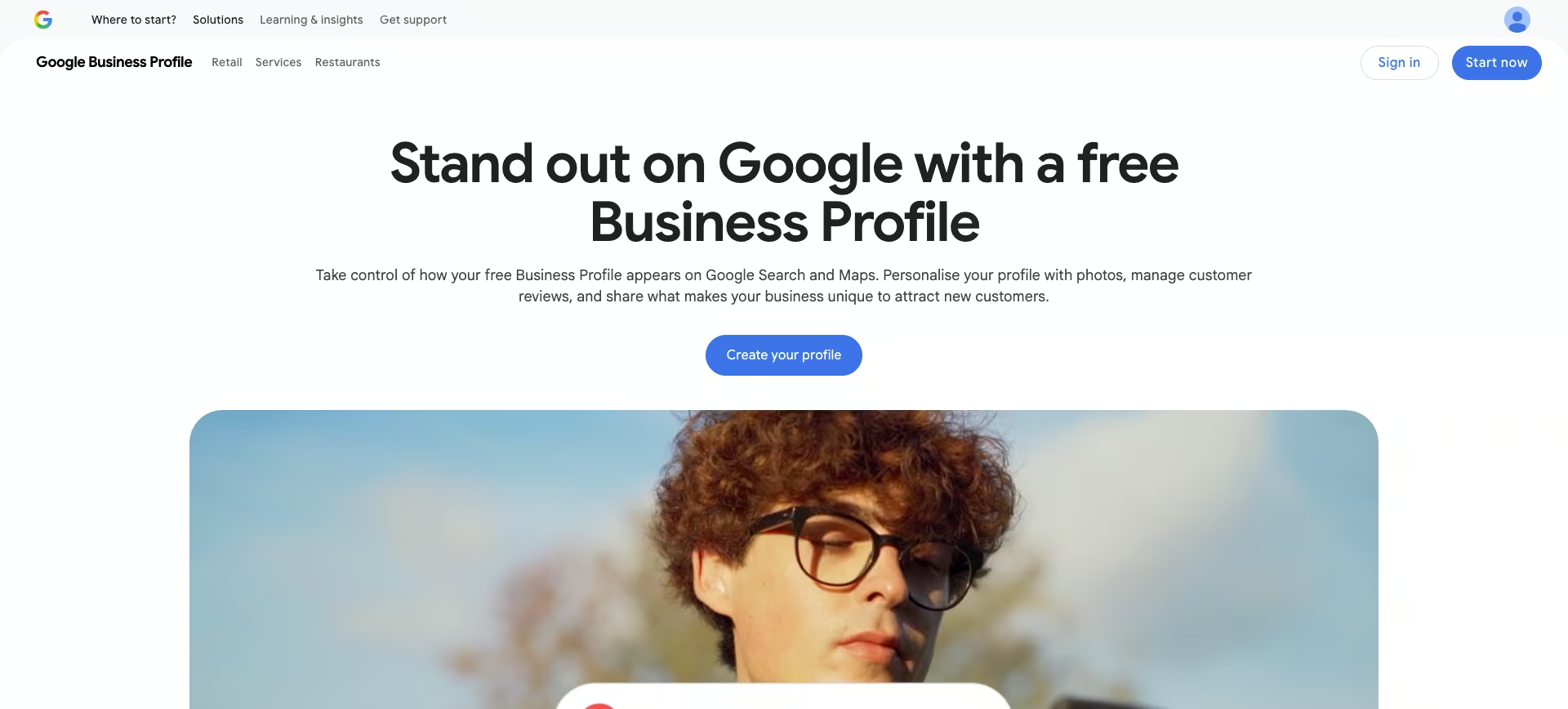
Your Google Business Profile is the single most important asset in local SEO. It is the free listing that feeds the local pack and Google Maps. Yet only about 35% of small and medium businesses have claimed one, so a complete profile alone can put you ahead of many rivals.
Fill in every field: categories, services, opening hours, photos and a genuine description. Keep it current, because a profile that looks abandoned rarely ranks. A few minutes of upkeep each month does more than most owners expect.
Your primary category carries real weight. A dental clinic listed as 'Dentist' will out-rank one listed only as 'Medical clinic' for dental searches. Choose the most specific category that fits, then add secondary ones for the other services you offer. Photos help too, since profiles with images draw more clicks than bare listings.
Earn and manage reviews
Reviews may be the strongest prominence signal you control. 97% of consumers read reviews for local businesses. Expectations have climbed fast. In 2026, 68% expect at least a four-star rating, up from 55% a year earlier, and nearly half skip a business with fewer than 20 reviews.
Recency matters as much as volume. 74% of readers prefer reviews from the last three months. So ask happy customers to review you, reply to every review, and keep a steady flow coming rather than a burst once a year.
Replying is not just courtesy. A thoughtful response to a poor review shows future customers how you handle problems, and it signals to Google that the profile is active. Make asking part of the job: a quick message after a completed sale, with a direct link to your review page, turns a good experience into a public one.
Keep your NAP and local citations consistent
NAP stands for name, address and phone number, and Google expects yours to match everywhere it appears. Local citations are the mentions of that NAP on other sites: directories, listings and local guides. When your details conflict across the web, Google trusts you less and may rank you lower.
Audit your listings, fix the mismatches, and use the exact same format every time. This consistency is part of the entity signals that tell Google you are one real business, not several loosely related ones.
In Singapore, the citations worth getting right start with the obvious ones: Google, your own website, and your social profiles. Beyond those, industry and local directories matter, from sector listings to community guides your customers actually use. You do not need hundreds. A dozen accurate, well-chosen citations beat a long trail of inconsistent ones.
Once your listings are consistent, you can earn stronger local backlinks in Singapore from partners and local press.
Publish locally relevant website content
Your website still matters, because Google reads it to judge relevance. Publish pages that name the areas and services you cover, in the plain language your customers use. A single generic 'Services' page rarely ranks for local searches. It also helps to get the way your website itself is built for search right, so a slow or messy site does not undermine the local signals you send.
Think in terms of pages a local customer would search for. A renovation firm might have separate pages for the neighbourhoods it works in, or the specific jobs it takes on. Each page answers a real local query and gives Google another reason to connect you to it. To find the exact phrases your customers type, follow our keyword research process for Singapore businesses.
Write for the customer first, and the ranking follows.
What local SEO mistakes keep Singapore businesses invisible?
Most businesses that struggle with local SEO are not doing anything exotic wrong. They are making a handful of ordinary mistakes that quietly cap their visibility. These are the three that come up most often.
Leaving the Google Business Profile half-finished
A blank or barely-filled profile is the most common reason a business stays out of the local pack. Missing hours, no categories and no photos give Google little to rank and give customers little reason to click. The fix is unglamorous but effective: complete every field, add real photos, and check the details are right.
Asking for reviews once, then going quiet
A cluster of reviews from two years ago does little for you today. Buyers weight recent reviews heavily, and a profile that has gone silent looks stale. The fix is to make review requests routine, not a one-off campaign, so fresh feedback keeps arriving month after month.
Letting your business details drift across the web
Old listings with a former address, a changed phone number or a different spelling of your name confuse Google and customers alike. Each mismatch chips away at trust. The fix is to track down your listings, correct the stragglers, and settle on one exact format you use everywhere from now on.
Should you do local SEO yourself, or hire an agency?
The basics of local SEO are genuinely do-it-yourself, and many Singapore businesses should start there. Claiming your Google Business Profile, asking for reviews and fixing your NAP cost nothing but time, and none of them need special expertise. For a small business finding its feet in local search, doing it yourself is often enough to get moving.
Local SEO starts to justify help when the work outgrows the basics. Competitive niches, several locations, building citations at scale and content that keeps pace with rivals all take time you may not have. The choice between keeping local SEO in-house and paying an agency to maintain it deserves a proper weighing of cost, control and time, which we have set out in full.
Local SEO also compounds in a way paid search does not: the profile, reviews and citations you build keep working long after the effort is made. If you would rather hand that ongoing work over, our SEO team can take on the parts that need scale.
Is local SEO still worth it in 2026 with AI search?
Yes, and arguably more than before. The signals that win local SEO are the same ones AI answer engines lean on when they recommend a business. A complete profile, strong recent reviews and consistent details make you the safe, well-evidenced answer for both Google and AI tools.
How people search is shifting, though. BrightLocal reports that the share of consumers using Google to find local businesses is slipping, while use of AI tools like ChatGPT for local recommendations jumped from 6% to 45% in a year.
The practical response is not to chase every new tool. It is to keep your fundamentals so clean that whatever does the recommending has no reason to overlook you. This is part of where search in Singapore is heading, and the businesses that prepare now will be ahead.
Frequently Asked Questions
How long does local SEO take to show results?
Most Singapore businesses see early movement within one to three months, with stronger results over six months and beyond. Claiming and completing your Google Business Profile can show up within days. Reviews and citations build trust more slowly, which is why local SEO rewards consistency rather than a one-off push.
Does local SEO work if I don't have a shopfront?
Yes. Service-area businesses like plumbers, cleaners or mobile tutors can rank in local search without a physical storefront. Google lets you set service areas on your Business Profile instead of a public address. The same levers apply: complete your profile, gather reviews, and stay consistent across the web.
What's the difference between local SEO and regular SEO?
Regular SEO aims to rank your pages in the standard Google results for any relevant search. Local SEO focuses on being found by nearby customers, mainly through the local pack and Google Maps. They overlap and both need ongoing upkeep, but local SEO adds the profile, reviews and location signals that general SEO does not.
Where to start this week
Start with the lever that moves fastest: your Google Business Profile. Claim it, complete every field and add real photos today. Then ask your three most recent happy customers for a review, and check that your name, address and phone number match across your website and top listings.
Those three actions alone put most Singapore businesses ahead of local rivals who have left their profile half-finished. If the ongoing work starts to outgrow your time, that is the moment to talk to an SEO partner who knows the Singapore market.
{{build-better-experience="/directory"}}
Categories
Written By
.webp)
Resources
Related Articles
Deep dive into our latest news and insights.